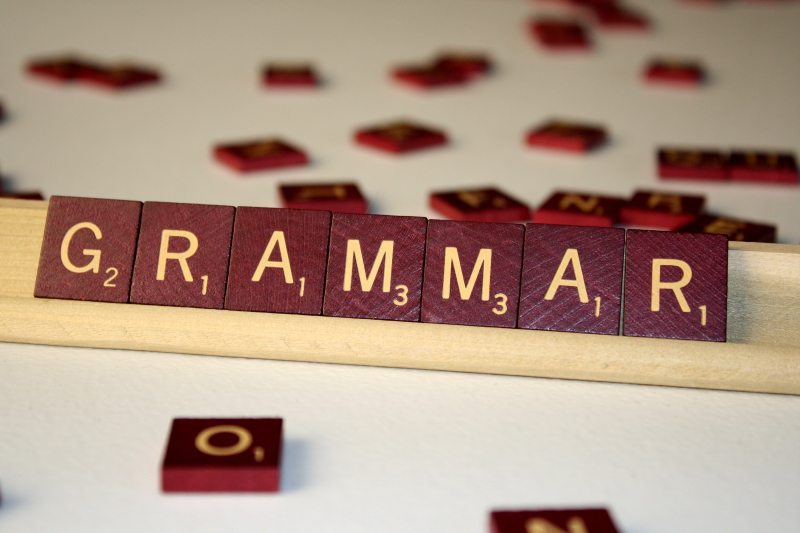
Since I'm a writer/author, I must have at least a basic knowledge of grammar. However, in today's media articles/posts/comments, etc., there are so many errors it makes one wonder if there's even an attempt to teach it in school anymore.
Having said that, it's useful to know the correct forms to use for the language in which you choose to write. (Notice how I structured that last part of the sentence? "in which you choose to write" instead of "language you choose to write in" because sentences are not supposed to end in a preposition.) Not ending a sentence in a preposition is nearly impossible in some cases, and in those specific cases to avoid ending the sentence in a preposition would sound/read awkwardly and/or stilted. In other words too formal for the circumstance.
And excuse the following expression but the "grammar nazis" often have a field day with methods used in writing which are less formal. That's where I have my problem with some demands from those who wish to hold to the staid rules of formal grammar.
I'm of the opinion that in order to break the rules successfully, you have to know them well. It's something that certain tones in the telling of a story or the circumstance of an article will demand: less formality and the nuance(s) of the commonality of mere expression, slang, or comfort wording. These choices lead to an authenticity that formality would not present or allow. Now if a writer/author is not writing in a contemporary genre, it's far more acceptable to keep the formal uses of grammar intact.
I prefer not to capitalize the various references/addresses of a person in dialogue such as: "Hey, son!" "Hi, babe." "C'mon, hon." However, proper/formal grammar insists each should be "Hey, Son!" "Hi, Babe." "C'mon, Hon." That's too many capitals and it's distracting. And really not particularly important for those "titles" to be formalized with a capital letter. Just my opinion of course. Remember when Mom and Dad were capitalized regardless of whether or not they were preceded by "my". Well, now if Mom or Dad are preceded by "my" or "his" or "her", etc., it's supposed to be "my mom" or "my dad" ,etc. Please explain how that makes any sense!
Just a few thoughts about writing and grammar this Wednesday . . .
Father, thank you for valuable instructions, the most valuable in your Word where truth surpasses everything else. We're all desperate for you in everything we do or attempt whether we know it or not. Thank you is never enough. In the Name of Jesus, Amen.


 Into the Fire