The Lord is close to the brokenhearted
and saves those who are crushed in spirit.
Psalm 34:18 (NIV)
The Lord is close to the brokenhearted
and saves those who are crushed in spirit.
Psalm 34:18 (NIV)
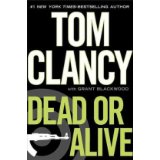
It’s personally amusing that my first read of a Tom Clancy novel turns out to be Dead or Alive which runs 950 pages. Me: the one who exalts long novels and wrote my first one that resulted in 744 pages including the Glossary of Terms. So what did I think of paddling through that many pages? Not too bad.
Dead or Alive is a contemporary thriller in the vein of Vince Flynn stories. With “spooks” and politicians and Islamic terrorists, an independent group of men, including former President Jack Ryan Sr.’s son Jack Junior, search for those terrorists the administration in this novel seek to placate with fancy diplomacy and the reduction and/or replacement of professionals in the CIA and other important places in the government with those who know nothing about what is required to keep this country safe. Sound familiar? Yeah, I thought so too.
This independent group seeks out the best of the Special Ops, Law Enforcement, CIA types who are considering retirement or frustrated with the limitations placed upon them by their government when the enemy has no such guards over their conduct to destroy the USA. Using their contacts and familiarity with other clandestine operatives and organizations in the world, this small group can accomplish what sanctioned operatives sometimes cannot. They operate totally under the radar and only answer to their peers.
As you might expect from a novel this size, the tedium of explanations for different radioactive parts, the voyages to unheard of and desolate places with the outcome predisposed and assured, and the few meandering and vulgar musings of a high-priced call girl, not to mention the probably accurate descriptions of the Arabs’ thoughts who hire the women for their “physical needs”, all lead to some perhaps unnecessary verbiage. This is a secular/general market book so there are no restrictions on language or vulgarity, and all things considered, in those respects it could’ve been worse. Plenty of f-bombs and some lewd imagery and words, so I don’t recommend it for everyone.
An antagonist equivalent to a bin Laden type, the “Emir” cannot be located, and the e-chatter has gone silent which is, according to Jack Jr., a good indicator that something big is in the works and possibly imminent. With Jack’s and another of the group’s geek’s discoveries the team takes off in twos to various parts of the world to capture some of the discovered evil members of the terrorist group (URC) to learn the plans and location of the Emir.
The covert operations are the most entertaining and exciting parts of the story, and the fact that none of them are discovered make the actions that much more fulfilling to read. Realistic in its portrayal of two kinds/sides of politics and government as well as the dangerous and sometimes tragic world of covert operations bring this contemporary story to life.
Writing-wise I found the use of nicknames and real names used for the same characters confusing at times in keeping track of who was who. Small thing really, but being unfamiliar with them kept me off-balance and stopping to reassess their identities. The POV slippages and opting into omniscient will no doubt bother some readers—though probably only those who write.
For those political/spy thriller readers who appreciate a lot of technical data streamed through stories, this is the book for you.
I’ll tell you the part of the novel I liked the least. In fact I’ll quote it for you, stated by one of the primary characters John Clark, a go-to guy in Special Ops. In putting his thoughts together with a few other incidents and nuances in the novel, I’m not sure if this is just the character’s thinking or if this is Tom Clancy’s opinion. Frankly, it bothered me.
***SPOILER ALERT***
Clark had never met a bad Saudi. There were a few he knew well from his life in the CIA, people from whom he’d learned the language. They’d all been religious, part of the conservative Wahhabi branch of Sunni Islam. Not unlike Southern Baptists in the thoroughness of their devotion. That was fine with him. He’d been to a mosque once and watched the exercise of the religion, careful to stay inconspicuously in the back—it had been a language lesson, for the most part, but the sincerity of their religious beliefs was evident. He’d talked religion with his Saudi friends and found nothing the least bit objectionable in it. Saudis were hard to make as close friends, but a true Saudi friend would step in front of the bullet for you. Their religion’s rules on such things as hospitality were admirable indeed. And Islam prohibited racism, something Christianity had unfortunately left out.
***SPOILER CONCLUDED***
Obviously, “John Clark” or possibly Tom Clancy has no clue what Christianity truly is or what the word of God has to say about racism. Not to be naïve about seeing prejudice in the church. Nevertheless: prejudice is not a part of Christianity; it’s a part of humanity.
Written in partnership with U.S. Navy veteran Grant Blackwood who also co-authored two novels with Clive Cussler and authored his own Briggs Tanner Series, Dead or Alive by Tom Clancy will provide a detailed story about what it takes by covert operatives to defeat a powerful, persistent, and remarkably patient enemy.
Father, I have no idea what Tom Clancy’s “religious” status is, but I know the only thing that matters in this world and the next is a relationship with Jesus. I pray that Tom would have one and that you would continue to enlighten his writing. In the Name of Jesus, Amen.
That catchy little title is a favorite phrase used by editors in various other forms such as “If it doesn’t advance the story, what’s it doing there?” Well, it’s an ambiguous question and another of the many, seemingly endless, “rules” for guiding writers along in their creation of novels. Frankly, I like it about as much as I like the “conflict on every page” fiasco. Maybe less.
A storyteller knows there must be a problem, a conflict, and/or tension to carry a plot. Genre dictates how much and how deep and how it’s presented. Peripheral characters provide all kinds of nuances for a story, some vague, some critical, some for misdirection, some for pure entertainment.
Once again let me give this disclaimer: the rules hold value and serve a purpose in teaching the basics for those who are picking up their pencils or exercising their keyboards and learning the objectives of telling a story. But the rules don’t teach variety or voice, vision or vivacity. Rules must be learned in order to effectively break them. Sticking religiously to the rules is the bane of creativity because not all rules translate effectively into making a good and stylish story.
Opinions on what truly “takes away from the story” are as varied as the stories themselves. It could be said that Dean Koontz does this frequently—heads off on little independent creative jags with characters and occurrences which take the reader away from the direct storyline and interject it with quizzical characters and circumstances that seem like rambling until down the line these unique people and situations intersect. Now it could be argued these are essential to the story . . . eventually. But the opposite could be argued as well depending on your view of what’s important to a particular story.
I just read Tom Clancy’s 950 page Dead or Alive. Apparently his editors didn’t think any of those hundreds of thousands of words weren’t necessary to his story.
It boils down to opinion. The concern seems to be that gushing prose provides mere pleasure for the author and not necessarily the reader which of course can be true. However, what might bother one reader—or one editor—delights another. Unrelated tangents by an author can read whimsically or irritate impatient readers. And not just impatient readers to be fair. If a target reader decides a passage is irrelevant and wonders why it’s there, the author has missed his mark with it. How critical the results of that failure are probably can’t be calculated in real terms. Some readers are quite forgiving and others seem to look for an excuse to abandon a book or an author. If it’s a technical concern about “the way stories should be written”, that only goes so far. Creativity and sound writing can bag the accepted norms with great success.
So what “takes away from the story” is just another “rule” that suffers from the ambiguity of opinion. Betting you hold your own opinions on this . . .
Lord, we’re desperate for you in all areas of our lives. Lead us in your ways and may your grace flow through us. In the Name of Jesus, Amen.

Continuing the CFBA Tour for July: The second Roland March Mystery, Pattern of Wounds, published by Bethany House and written by J. Mark Bertrand, reminds us of our first go-round with Houston Police Department Detective Roland March. He’s cynical, can be abrasive, and he’s not about to submit to the perfect by-the-book investigations regardless of the reprimands involved when following his gut.
In a strict and exhaustive timetable approaching the Christmas holiday, we feel the fatigue and hear the silent clock ticking away the hours of chasing down leads, suspects, and the disappointments for a crime which eventually erupts into a second murder.
When a posed and carved up dead girl turns up by the pool of a female professor’s home where she was a boarder, there’s something eerily familiar about how she’s carefully positioned. When it hits March why he recognizes the layout of the crime, no one is willing to see the similarity. Except someone who is almost as familiar with the old crime as he is.
In the meantime the young Christian couple, Carter and Gina who were introduced in Back on Murder and who now rent March and Charlotte’s attached apartment, tentatively announces they are having a baby, knowing it could be difficult news since March and Charlotte lost their little daughter in a car crash. The news dredges up instant pain for March and multiple senses of loss. Along with this sorrow we learn more of March’s family background and none of it adds up to comfort and joy.
Roland March is an embittered, dedicated perpetrator of justice who holds a grudge the size of Texas against a God he can’t understand, refusing to try even when some things smack him in the face. Mark captures his character, unflinching at the exposure of his sometimes cold heart and his sometimes uncomfortable devotion to his wife. The detective is complex with multi-layered feelings even he can’t always rectify. As we learn more about his personal history in this second leg of the March journey, we can’t help but think much of his demeanor is a result of deep hurts he’s unwilling to turn loose. They’re as much a part of who he is as the brusque sarcasm, sharp wit, and unorthodox investigative hunches and practices.
Pattern of Wounds not only presents the reader with a great cover and a title full of innuendo, the story takes you step by step through the frustrations of pursuing the wrong suspects, the interference of a misled author, the deceptive efforts of an incarcerated murderer, and the histrionics of a deputy sheriff bent on attaching a serial killer to March’s murder victim.
Even more “noir” than its predecessor, Pattern of Wounds by J. Mark Bertrand leaves us uneasy in the final scene but ultimately fulfilled for having read a so well-written and strangely touching story filled with dog-legged subplots and a more intimate look at Roland March.
God, you’ve clearly gifted Mark. Please continue to meet the supply of stories for those readers you’ve provided and will provide. Bless his efforts to show both sides of the spiritual journey. Keep him and Laurie safe from all harm. In the Name of Jesus, Amen.
The 2011 Christy Awards were given out at the annual dinner held the evening of July 11 at the Hyatt Regency Hotel in Atlanta, Georgia.
The awards began just before 7 p.m. local time with Emcee Liz Curtis Higgs welcoming the attendees, after which the nominees were announced, and each of the authors went onstage where they received a medal (the winners received trophies). After the meal Donna Kehoe the executive director of the Christy Awards presented the year in review, followed by the keynote speech by Randall Wallace. Around 9:15 the 2011 Christy Award winners were announced.
The Christy Awards were first awarded in 2000, and honor each year excellent Christian fiction, in a variety of categories. Each year publishers submit books for the categories and the winners are chosen by a board of seven people familiar with the publishing world.
The nominees and winners of this years’ Christy Awards are: (Winners are in Bold)
Contemporary Romance
Blood Ransom by Lisa Harris
Indivisible by Kristin Heitzmann*
Sworn to Protect by DiAnn Mills
Contemporary Series, Sequels, and Novellas
The Reluctant Prophet by Nancy Rue *
The Thorn by Beverly Lewis
The Waiting by Suzanne Woods Fisher
Contemporary Standalone
Almost Heaven by Chris Fabry*
Lady in Waiting by Susan Meissner
A Season of Miracles by Rusty Whitener*
First Novels
Crossing Oceans by Gina Holmes*
Heartless by Anne Elisabeth Stengl
A Season of Miracles by Rusty Whitener*
Historical
Chosen: The Lost Diaries of Queen Esther by Ginger Garrett
For Time & Eternity by Allison Pitman
While We’re Far Apart by Lynn Austin
Historical Romance
The Girl in the Gatehouse by Julie Klassen
She Walks in Beauty by Siri Mitchell
Within My Heart by Tamera Alexander
Suspense
The Bishop by Steven James*
The Bride Collector by Ted Dekker
Predator by Terri Blackstock
Visionary
To Darkness Fled by Jill Williamson
Konig’s Fire by Marc Schooley
The Last Christian by David Gregory
Young Adult
The Charlatan’s Boy by Jonathan Rogers
The Healer’s Apprentice by Melanie Dickerson
Motorcycles, Sushi, and One Strange Book by Nancy Rue
Nancy Rue became the first author to win two awards in one year. (All information taken from the Christy Awards Website.)
* I've read these.
Father, please bless those who write for your glory. No award can beat the pleasure of our obedience to you. Thank you for that privilege. In the Name of Jesus, Amen.
Robin Parrish’s latest, titled Vigilante and published by Bethany House, is one of the featured novels in the CFBA Tour for this week. This is my third read from Robin Parrish who writes always interesting types of speculative fiction, just not my favorite types of reading. Until Vigilante. I really liked this novel, clearly my favorite of the three I’ve read. And may I add just a side note here? I loved that he only included one “blurb”, from Ted Dekker no less and on the cover, but just one. Kind of refreshing.
Writing a story which conjures up comparisons to a more fleet-footed Robocop while situated in a pre-apocalyptic New York City, Robin opens with a bang (forgive the pun) and keeps the tension and conflicts going right up to the satisfying end of the story. Shortly after a celebrated Special Forces soldier Lt. Nolan Gray, a well-known war hero and personal friend to the current president, is dead and buried with honors, mysterious billboards lead to a figure who starts rescuing different people from crimes against them, claiming to want to show them a “better way” to live. He doesn’t speak. Instead he performs amazing acts of offensive maneuvers to disable those who seek to wreak havoc on the patrons of NYC. The press labels him “The Hand” due to the design of the billboards and a white hand insignia on the strange combat suit he wears which seems to make him indestructible.
Vigilante is filled with techno-gadgetry that will satisfy the geekiness in anyone and fill the reader with images of comic book superheroes. Although the high-tech magic of the hero’s equipment proves to be all it’s supposed to be, the actually alive Nolan Gray isn’t infallible and soon comes under scrutiny by those he’s trying to bring to justice.
With the heart of a warrior and a love for Jesus, “The Hand” becomes the target for a hefty Russian mobster and a prying newspaper reporter working hard to reveal his identity.
There are multiple themes in this unique novel, presenting a hero filled with a sense of justice and a desire to inspire people not to succumb to the evil threatening to destroy their everyday lives. Somehow along the way when tragedy and heartbreak attack his soul, he loses part of who he is in this fight but refuses to quit until one specific monster is vanquished. Tackling moral ambiguity, the element of unintentional self-righteousness and reliance, the meting out of justice, hopelessness and helplessness, and the constructs of evil, Vigilante packs a punch in more ways than the obvious.
The cast of Nolan’s cohorts consist of an older fellow soldier, a master geek who abstains from weaponry, and a motherly woman who Nolan rescues from abuse. A few places in certain situations the dialogue sounds stiff, but it’s not pronounced throughout the novel. Parrish keeps Nolan consistent as he slides more desperately into perform-at-all-costs/soldier-mode and caps the story with a positive ending.
Vigilante is a moving tribute to many things. It appeals to my sense of justice. It paints the actions of a war hero with grace and humanity. It allows the reader to make conclusions and injects faith issues into complex situations. This is a great story, and Robin handles it all very well. His best book to date in my opinion.

http://www.amazon.com/exec/obidos/ASIN/0764206087
Father, please continue to instruct Robin and bless his writing. Provide those important themes for his work and allow him the opportunities he needs to produce them. Watch over him. In the Name of Jesus, Amen.
From the fruit of his lips a man is filled with good things
as surely as the work of his hands rewards him.
Proverbs 12:14 (NIV)
If we believe the terminology the Obama Administration is using as they push for a debt ceiling increase, the United States is headed for an economic “disaster of biblical proportions.”
How our nation got here and how we move forward is as much about principle and our moral obligations as it is about the trillions of dollars Washington is currently arguing over.
As stewards of what we have been given, what is our responsibility and our leaders’ responsibility as our nation continues to rack up enormous amounts of debt? What impact will this debt – largely owed to China – have on our children and grandchildren’s future?
Please read my latest piece on this important topic for the new ACLJ blog, The Docket. As Americans of faith, we often direct our energies into issues related to life and the family. The amount of debt that our nation has incurred is proving to be a tremendous threat to every American family today and to our future. Please share this article – and the in-depth resources of the new ACLJ.org – with your friends and family by forwarding this email, and sharing it on Facebook and Twitter.
Jordan Sekulow
ACLJ, Director of Policy and International Operations
God, we are desperate for your mercy and direction. In the Name of Jesus, Amen.
(Thanks to BK Jackson for her thoughts on this topic. I needed a post for today.)
When is it too much? If I’m reading a Robert Liparulo novel, there’s always a huge amount of conflict. The master of pacing in his early thrillers and in his Young Adult Dreamhouse Kings Series, conflict rules and reigns on page after page. The pages can’t turn fast enough. Even with proper chapter breaks, it’s difficult to stop turning those pages. So. Robert knows all about conflict and how to keep it sharp and fresh.
Reading a Lisa Samson novel presents a different kind of address to conflict. It can be subtle, sometimes slow-moving, other times overt, and in its own way a quiet life-and-death literary treatise of pain, struggle, and growth. Not atypical of literary novels but never less than real and honest in the department of the human psyche and its varied emotional and spiritual makeup.
The “must have conflict on every page” instruction grinds on me. Another “rule” that exceeds sensibility and needs translation. When you use this premise for a romance what you get are doofus characters pretending they don’t like each other when it’s blatantly obvious they want to rip each other’s clothes off. Exaggeration, okay? But, hey, that kind of conflict results in shallow characters playing junior high school games with each other and makes me, as both a writer and a reader, want to shred pages of said books. Frankly, it’s insulting. Apparently there are several readers who enjoy being insulted with this kind of behavior. It’s exceedingly difficult to pull off this stuff in the content of romantic fiction because it’s so disingenuous—especially after the back cover copy reveals the storyline with the hint-hint, wink-wink suggestion or question.
Your approach to conflict in story might prove quite revealing in your genre and author tastes. Your thoughts on this are welcome . . .
Father, you know the conflicts of the ages. It all began with sin. Help us to honor you with the way we write, the way we depict the struggle. In the Name of Jesus, Amen.
Would appreciate your continued prayers for those mentioned yesterday. My brother is facing possible heart surgery. He’s stable but needs prayer. Thank you all. May the Lord richly bless you for lifting up the needs of others.
Here are some very real prayer needs. Hope you will invest your time to join and assist these people in asking God for His best in dire situations. Sorry that some of the information must be vague. May the Holy Spirit guide your prayers. Thank you to all who recognize the needs and understand the value and power of prayer.
Lee Hough, Alive Communications Literary Agent: Brain surgery (Thursday) for tumor
Becky: Author's daughter
Another author's son.
Adding my brother Richard who's been admitted to the hospital with pnemonia this morning.
In the Name above all Names, the Name of Jesus, please intervene, God. You are supernatural and miraculous. Help each one, Lord, as only you can do.

