Into the Fire

Passionate thoughts about the world of writing and the Power of God

  • Favorite colors: Black and Yellow

    Our racing colors (for our silks and equipment in horse racing) were red, black, and yellow because my favorite colors are black and yellow and my husband’s are black and red.

    Three of the more unusual names of horses we trained were Lunch Bag, Rattlesnake Dancer, and their son (years later) Rattle Bag.

    We own two retired Thoroughbreds. Both were born on our property. They’re mother and son.

    I honestly don’t remember a time when I didn’t love horses. My husband “discovered” them at 14 when he started working at the track during summers. He stayed in the racing industry for over 30 years. I “discovered” I could actually work at the track when I was 20. I stayed for over 30 years too.

    Father, thank you for all the blessings, for allowing us to meet you at the racetrack of all places, and for giving us the opportunities to learn and grow through all the hardships. We’re still desperate for you, and you’re still all we’re livin’ for. In the Name of Jesus, Amen.

  • Had enough yet? I bet you have.

    A singular event, combined with others of similar substance, and the thought processes which followed it prompted the past few posts on “disclaimers” in regard to writing.

    Some of you might know or remember that my first novel Hope Of Glory is a comprehensive story about American horse racing written in the language, lifestyle, and culture of the track. Self-published and with a thoroughly Christian perspective contrasted to the worldliness of a typical racing community within its pages, this novel, as I’ve written here, is a genuine first effort in the technical aspects of writing. Not a good example of my much improved writing skills. Nevertheless, when I hear so specifically from the Lord, it’s at my peril to disobey. My first novel, of monster-size, was an act of obedience.

    So, having said all that, when I give my first book away, I always qualify it with the stipulation or disclaimer that it’s a “first” novel and what all that means. Plus I explain there are some raw scenes and characters included in the story, very real examples and composites of actual people I’ve known.

    I gave one to a lady at church with all my disclaimers because I didn’t know the woman very well and, as I said yesterday, I do not want to offend readers. The following Sunday she told me she was loving the book. I asked her how she was handling it, and she told me she preferred the realism. It made we wonder why I go to such lengths to explain my work to people.

    But then I’m reminded of the hurtful comments made on this blog to me because I gave honest reviews of a couple of novels which either had particular characters, writing styles, skill sets, or plots I didn’t like.

    Ah well. Such as I am . . .

    You know me, Lord. Just keep workin’ on me, Jesus. Got a long way to go . . . In the Name of Jesus, Amen.

  • Yesterday I said: “Personally, I value disclaimers, or I should say I would value them by an author for a very simple reason: honesty.”

    We can always hope that a reader who scans general genres for valuable reading, but focuses on specific genres, might land upon our work and venture into our stories resulting in “Hallelujah” praise at the experience. But the horrible reverse of that is also a possibility.

    I’ve learned that certain readers of Christian fiction are easily offended by characters or plot elements that experience or depict the sinful conduct of the world in any other way than general references. That important factor eliminates my novels from their prospective book lists. And I want that elimination—because I would rather not suffer outrage from readers for portraying the lost without judgment. In order to do that, my approach conveys the attitudes of the heart and the conditions of the soul. Not always pretty, certainly not fluff, and without graphic circumstances but with a certain level of ugliness exposed, some characters experience life without Jesus.

    I’m not a fan of the “edgy” description for writing. It’s overused in writing circles in an attempt to explain or perhaps warn readers that a book contains any number of potentially offensive items. The term is broad and unspecific and has become trendy in some cases. Although it alerts readers such as myself that the novel isn’t meant to be fluff, I’ve written about the “one reader’s/writer’s edgy is another’s . . .” fill in the blanks. At least it’s an attempt to keep fragile readers from picking up a book they might find offensive.

    All that to say this: I tend to give disclaimers concerning my novels. I want those who read them to know they are not stepping into a sweet little romance. They will meet characters who don’t know the Lord and live accordingly. They will encounter the motives behind conduct in sinful lifestyles. They will observe the contrasts between the lost and the found in story form.

    In today’s publishing circles I’ve noticed a heightened level of hype. Overdone. Over the top. Too much for some of the products to live up to in an appeal to reach readers who won’t appreciate the type of book being promoted. In the practice of writing queries and proposals, the question asks the obvious: Who is your audience? Authors can wish for a large audience from Karen Kingsbury’s readers to Ted Dekker’s readers, but will their books truly appeal to those readers? And will the ability to market to those groups exist in real time, authentic and effective strategies?

    Any thoughts?

    Father, help me to tell the truth about the stories you’ve given me to write. I couldn’t write one word without you. In the Name of Jesus, Amen.

  • Disclaim: To deny or renounce any claim to or connection with; disown. To deny the validity of; repudiate.

    Disclaimer: A repudiation or denial of a claim.

    Let’s say there’s a product on the market making claims such as “miracle cleaner”. Oh wait, there are such products. Okay. If you pass on this information about the product to someone else because of what you’ve heard about the product, the disclaimer you give is this: “But I’ve never used it so I don’t know for sure if it does what it’s advertised to do.” Fair enough?

    Let’s do what I inevitably do one way or another and transfer this to the writing world.

    The “miracle” claims on book jackets, through endorsements, or written within reviews by those who’ve actually read the book present the product for readers. Some readers base their selections of books on exactly those claims. After reading the book, they either join the “miracle” mantra or offer their own versions of a disclaimer.

    We don’t hear disclaimers from the authors of their books very often. Why? Because authors need sales, it’s not a good marketing technique, and disclaimers do discourage some people while challenging others. Personally, I value disclaimers, or I should say I would value them by an author for a very simple reason: honesty.

    I’ve stood in fiction aisles where Christian fiction is sold and asked those browsing the covers what kind of stories or what authors they like. When they respond with a few titles or authors’ names, I know immediately what kind of writing and storylines they prefer. I know instantly if my novels will fit into their reading world.

    The importance of recognizing “your” audience as a writer is tantamount to me. I know my audience will not be found in the Amish/Prairie Romance crowd. Huh-uh. The last thing I want to do to a reader is offend them with my story or the way it’s written. Very few authors gain universal appeal. Many more novelists have niche readers even though that niche can be far reaching.

    Many of today’s CBA thrillers contain a substantial amount of gore. Some readers think they like thrillers, but what they really like are mysteries or suspense novels. It’s imperative to know the difference in reading tastes before recommending a Robert Liparulo, Steven James, or Ted Dekker novel to someone who appreciates Terri Blackstock or Lorena McCourtney, not that they can’t intersect (because I like all of these authors), but some readers would literally be horrified and even repulsed by the former authors’ books.

    Today’s point being: authors need to take responsibility for their “wares”. Even if only in their tag lines such as Brandilyn Collins has done with her copyrighted expressions: “Don’t forget to breathe” and “Seatbelt Suspense”. These suggest there might be a little more “scare” in the story than the average suspense novel. While these clever lines serve as an invitation to readers who love intrigue and some frightening plot elements, they also imply a subtle warning to those readers who’ve wound up joining Brandilyn’s “Big Honkin’ Chickens Club”.

    More about disclaimers tomorrow.

    Father, you’ve created all kinds of writers to tell the stories you’ve given to each one. You know the fears and struggles of your people, and your desire is to strengthen and encourage. To make us more than conquerors through your Son Jesus Christ. Help us to depend on you for all things. In the Name of Jesus, Amen.

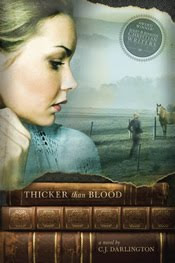
  • Tyndale Fiction sent out copies of C. J. Darlington’s first novel, Thicker than Blood, to interested reviewers for a January release. Thicker than Blood began when the author was only 15 years old, but its polished version won the 2008 Jerry B. Jenkins Christian Writers Guild Operation First Novel Contest. Some of you are familiar with C. J. and her sister Tracy from their TitleTrakk website where they review Christian books, films, and music, conduct interviews with Christian artists, and post polls and contests with lots of giveaways.

    In Thicker than Blood two sisters, Christy and May Williams, are young teens when their alcoholic parents crash and die in a car accident. Their Aunt Edna willingly signs up to take them into her home, but Christy drops off her younger sister May after the funeral and drives off alone to join her boyfriend in parts unknown. Many years later at the age of 32, Christy’s drinking is overtaking her life as she uses alcohol to numb her memories. Her recent ex-boyfriend Vince picks her up to avoid an overnight stay in jail for a DUI, and what she discovers about him after he’s gone to work to their mutual place of employment changes both of their lives immediately.

    Christy has a serious fondness for antiquarian books and works for a respected bookseller where Vince is also employed. With both Christy and Vince guarding secrets about themselves regarding their jobs, this mutual employment proves to be a devastating problem which the boss’s son eventually figures out. When May’s and Christy’s Aunt Edna dies, a close friend of the family visits Christy to inform her that Aunt Edna has left half of her estate to each sister and her massive library of books to Christy. Aunt Edna also leaves a letter for Christy, and that letter serves as the catalyst for a reunion with her sister.

    Mixed in with a fair amount of suspense are the desperate needs to reconnect and re-establish the emotional and blood ties which were never erased—just heavily obscured. Healing, forgiveness, and renewal wait to be given a chance to enrich the lives of two sisters in varying degrees of pain.

    C. J. is able to give us just enough of Christy’s pain to keep us hoping she can overcome her self-destructive ways and accept love and forgiveness. May is just tough enough to work her way through her pain and offer what Christy so desperately needs. Vince might have come off as a little too cliché, and his final appearance in the story seemed a tad too contrived, but the scene itself is well done.

    If you want to read traditional/commercial Christian fiction, Thicker than Blood fills the bill. There’s a solid audience for this kind of novel, but for those of you who flinch and moan at the typical use of faith issues in storytelling, this is probably not the book for you.

    A solid first effort for C. J., especially considering her age when she began this serious look at issues of forgiveness, abandonment, addiction, and faith.

    Father, you know the plans you have for C. J., and you know how hard she’s worked to fulfill what you have asked of her over the years. I pray you would continue to bless her life, her writing, and all of her efforts to put you first in her life. In the Name of Jesus, Amen.

  • In no particular order . . .

    Sitting in the sun reading a good novel

    Walking in our pasture–again in good weather

    Watching the TV shows I enjoy

    Walking the mall sometimes

    Drinking my morning Coca Cola

    Having read Mark’s, Dayle’s, Jessica’s, and Kristen’s writing

    Having the time I need to do most anything

    Worshipping in contemporary Pentecostal spirit

    Driving with my husband in his hot rod pickup or the big semi

    Being absorbed in prayer

    Lord, you’re all I’m livin’ for . . .

  • It is written in Isaiah the prophet:

    “I will send my messenger ahead of you,
    who will prepare your way” —
    “A voice of one calling in the desert,
    ‘Prepare the way for the Lord,
    make straight paths for him.’”

    Mark 1:2-3 (NIV)

  • THURSDAY

    At 10:30 the sun was out and the steam was rising from the wet grass around the barn area. Once again the track was muddy and hard in spite of all the efforts made to keep it in decent shape. It couldn’t be helped. It remained a wet spring.
    “Hey, Hutch. This little filly can be a snot, so watch her. She has a mind of her own,” Michael explained.
    “Gotcha,” he acknowledged. He patted her neck before he asked for her foot.
    “Hope the rain isn’t bothering you too much,” Michael said.
    “You know, since we’re not racin’ yet it doesn’t matter much to me. I know it’s hard on the horses and everybody who has to work in it, but all I have to do is shoe ‘em. Don’t have to be out in the weather so to speak.”
    “Yeah, that’s good. Just gets some people depressed, I guess. After awhile it even gets to me, and I was born here.”
    “Well, I came here depressed. The weather didn’t have nothin’ to do with it.”
    “My wife and I prayed about you and your wife last night. You know, as much as you obviously love her, I can’t see her bein’ able to turn that love off so easily at her end either.”
    “I really hurt her, Mike.”
    “Yeah, I know. I did the same thing to my wife. But she loved me enough to forgive me, and I bet your wife does, too. She probably did all the divorce stuff because that’s all she could think of to do. Did you have any family or friends or anyone tryin’ to get you two straightened out?”
    “Not really. My sister Sally was going to talk to her, but I talked her out of it. At the time she was still too hurt and mad, you know. It would’ve looked like the loving sister could see no wrong in her brother—it wouldn’t have worked. At the time I’m convinced nothing would’ve worked.”
    “What about now?”
    “I doubt it.”
    “I finally got my head on straight and wrote my wife a letter. Apologized for all the things I’d done. Even admitted she was right about them whereas before I’d never admit to any of them. Man, I put her through it. Sounds like you just had one incident—I did, too, but with me that one incident just capped off what I’d been doin’ all along. I’m embarrassed to talk about it all and ashamed. Thank the Lord He got a hold of me.”
    “So, you were a Christian when you went back with your wife?”
    “No, neither one of us was but almost right after we got back together we went to the former racing secretary’s wedding and got saved immediately afterward. It was incredible. Things have never been the same for either of us.”
    Hutch was quiet for a few minutes.
    “Look, Hutch. The truth is for us Jesus Christ intervened in our lives at exactly the right time. We needed Him. We had so much baggage to deal with—you know, just livin’ this lifestyle the way we did. Just a lot of garbage. It was destructive—I don’t know any better way to describe it. Now I’m not going to bombard you with Christianity every time you walk in this shedrow, but I can tell you this: He’s real and He cares about you and your wife. That’s all I’ll say. Fair enough?”
    “Plenty fair, Mike. Don’t worry about me. I don’t get offended easily. Besides, I’ve never really heard this. To tell you the truth, I had no idea this was what Christianity was all about. You really believe this, don’t ya?”
    “Hutch, Jesus Christ changed my life. He’s not a religion. He’s willing to meet you right where you’re at. He’s the solution to life. I’m not kiddin’.”
    “Sarah mentioned you had this good colt last year slab a knee. Weren’t you mad about it?”
    “Mad? I don’t know that I ever got mad. I was real hurt about it and frustrated, but I was grateful that we’d had the wins. You know, that incredible experience, yeah, I’d even say the all out joy and fun. I’ll be honest with ya, I cried. I took him over to the college for surgery, and a couple of times I cried my eyes out. My wife did the same thing. But you know, he got it when he was bumped—we saw the film and Robert told us he bobbled a bit. He coulda went down, but the Lord protected him. He won the race, for cryin’ out loud.”
    The filly Hutch was shoeing pulled her foot away from him. Michael shanked her.
    “This is that colt’s half-sister. She’s tough, but she doesn’t have his talent. She’s honest out there, though, and that’s all we can ask.”
    As the two men talked, a friendship began to form. They conversed easily and enjoyed each other’s company. The shoeing went quickly and they made an agreement to get two more tomorrow.
    “Thanks a lot, Hutch. If these horses don’t run good this year, it won’t be your fault. Man, you do nice work.”
    “Thanks, Mike. See ya tomorrow.”
    Once again as Hutch was putting his tools away a man drove up and introduced himself.
    “Hi, I’m David Renner down in Barn 1. I’ve got 15 head down there, and George Rogers is too busy for me now. Was wondering if you could take over for him. Heard some good things about you.”
    “Well, thank you, Mr. Renner. Just call me ‘Hutch’. Sure. I’d be happy to. I’ve got a bunch to do today, but I could start catchin’ some for ya at about 11:30 tomorrow morning. In fact, I probably could catch six or seven tomorrow. That be okay?”
    “That’d be just fine, Hutch. And call me Dave. My grooms will be there or my exercise girl Tonya. I’ll let them know what time you’re comin’. They’ll either be somewhere at the barn or in their tack rooms. We’re on the south side of the barn.”
    “I’ll find ‘em. Thanks.”
    Hutch went to Brady York’s barn and did five for him. Nelson had three for him after that. Bob had gone home. Hutch knew he’d have to meet him one day, but he just didn’t want to deal with any hostility yet. Right now, he felt like he’d had enough to last him a lifetime.
    “Hey, what’s goin’ on?” Nelson greeted him as he walked in the shedrow.
    “I’m ready to roll.”
    “You know Mick’s giving you the problem ones, don’t ya?” Nelson asked as he brought a crooked legged filly out of her stall.
    “So does that mean he has confidence in me or that Bob doesn’t want to do ‘em?”
    “Both.” Nelson laughed at Hutch’s perception.
    “Hey, bring ‘em on. Challenges keep me sharp, man.”
    “Does that include the personal ones?”
    “Very funny. Who’s this pretty thing with the every which-way legs?”
    “This is Cantine Drink, a solid sprinter. There’s an outside chance you might know her mother Cantine Cathy.”
    “I’ll be darned. Robert Sanders rode her a few times. I believe I even shod her once for Abe Johnson—he had an emergency at his ranch and had to get out there, and that mare was in that day, so I shod her for him and she won.”
    “Small world, huh?”
    “Seems to get smaller and smaller all the time.”
    Hutch started in on the filly. After a few minutes he asked, “You ever believe in God?”
    “Whoa, what brought that on?”
    “Well, have ya?” he persisted.
    “Yeah, I have.”
    “Really?”
    “Why so surprised? You think I’m too bad a dude to believe in God?” Nelson asked sarcastically.
    “Hey, cut me some slack now. How many people around here believe in God—or if they do will even admit to it? Not only that, if they say they do, you can’t tell any difference in the way they live from anybody else, so what difference does it make to them if they do?”
    “You know, I detect just a hair of hostility here. Someone been touchin’ a nerve, Mr. Horseshoer?”
    Hutch put the filly’s foot down and turned around. Calmly but firmly he said, “You know, Nelson, my life is turned completely upside down. To tell you the truth, I’m operatin’ on sheer instincts or habit or somethin’. I’m a grown man and I’ve been in my share of scrapes and trouble—never backed down from a fight. I ain’t no wimp, but, damn it, I feel like I’m about to lose my mind. I shouldn’t even be admittin’ this to ya, but it’s all I can do not to cry sometimes. My nerves are shot. It just flat ain’t easy to lose someone you love, and I ain’t handlin’ it very well.”
    Hutch turned around immediately and resumed shoeing the filly.
    Nelson measured his words, something he was very good at. “Hutch, I know where you’re at because I’ve been there. You probably thought when I said I had a female roommate livin’ in that house with me that I was over my wife. The girl that stayed with me was a friend. Her boyfriend was in the military so the situation felt safe for both of us. There isn’t a day that goes by that I don’t think of Cassie. I know I sounded flip about it when we first talked, but the truth is it broke my heart when she left me. I thought I was bustin’ my butt to be a good husband, but I quickly saw I was just doin’ my version of what I thought was good. Come to find out, down the line, of course, when all the intense hurt or anger or whatever wears off a little, she was right. Stupid thing is I let her leave. She didn’t really want to, but I let her. She wanted to figure out a way to work it out, but I thought she was too demanding. Turns out: I was.”
    “How long ago?”
    “It’s been three years now.”
    “You talked to her at all?”
    “Once a year. I call her on her birthday.”
    “She re-marry?”
    “No, not yet.”
    “Then why the hell don’t you get back together?”
    “Because I’m afraid I’ll do it all over again.”
    Hutch took that statement in, and it stung him. He continued to work on the filly.
    “But getting back to your original question, I don’t have any doubt there’s a God. At one time I knew Him pretty well. And it’s my fault that I’m not close to Him right now. The darn racetrack just sucks it out of you.”
    “Sucks what out of you?”
    “Everything. Your time, your energy, your money, your devotion to anything or anyone else. Shouldn’t be that way—and if the truth be known—it doesn’t have to be. Problem is I couldn’t get my priorities in order, so now this is all I have. The racetrack.”
    “Your wife—does she know God?” Hutch asked after a few moments.
    “Yeah, she’s a Christian. Probably why she hasn’t gone out and found a decent husband.”
    “What do ya mean?”
    “The bible gives adultery as a justifiable means for divorce.”
    “So I take it there was none.”
    “Nope. She had all I wanted. My unfaithfulness was with the horses. They consumed me and my time. I told ya she said I was married to the horses. She was right. People were impressed with my leg work. You know how now more than ever they’re startin’ to develop medications and surgeries that help these horses a whole lot more than rubbin’ on their legs is ever gonna do, but before we never used to have them, so I wanted to be the best leg man on the track—no matter where I went. By the time I was 25, I’d established my reputation, and I could work for anyone. I spent hours talkin’ with and learning from the oldest grooms on whatever track I went to—I talked to the ones who knew Citation and all the old great champions. It was phenomenal what they did to those poor horses, but when you modernized it with the new medicines and medications and everything, well, you could hold ‘em together when you had to.”
    “You sound like me. Wanting to be the best. At all costs, I guess. Doesn’t seem so stinkin’ important right now, I can tell you that.”
    “Roger that.”
    The two men continued in silence pondering their life situations. Hutch finished with Cantine Drink and pointed out a small change he’d made on the right hind foot. “If this seems to cause her any problems, I’ll fix it right back. It just seems like she wears it funny and once it starts growin’ out she’s gonna hit it the way it was.”
    “Bingo, cowboy. She only starts to hit two weeks into her shoein’. We thought she was just randomly hitting herself. You’re good, Hutch, and I mean that.”
    “The best, you know?”
    They both gave a helpless laugh.
    “Pathetic,” Nelson said.
    “I know.”
    Hutch drove down to Deborah Pattison’s barn and shod one for her before he went to his motel. He grabbed a few snacks and some juice out of a vending machine in the motel lobby and went to his room to take a shower. He ate a bag of chips and drank the juice and went to bed.

    (Excerpt from For His Glory; sequel to Hope Of Glory)
  • Not many writers will experience their work reaching this platitude. I’m sure there are certain authors who disdain such a distinguishing label because of many books which have made the bestseller lists of various publications. Nevertheless when a novel makes the New York Times Bestseller List, there is no denying that multiple readers have decided this is one book they want to read and want others to read as well.

    Let’s face it: the NYTBL is no guarantee of prestigious writing, but it does seem to guarantee, depending upon how long the novel stays on this list, the book tells a story which excites the interests of diverse consumers. From The Da Vinci Code to The Shack to multiple Karen Kingsbury’s novels, there is a definite leaning toward interests in spiritual topics written into story form. Whether atheist or Christian or with myriad other religious overtones, books that somehow confront, dispute, enhance, or simply exemplify spiritual stories have gained an audience.

    Most publishers aim high for the books they turn into print. At least they should. I know. We sometimes wonder what they had in mind when they publish some of what we’ve read. Is it crazy to expect them to always be on the hunt for that unique novel which will have wide appeal beyond the niche-type books we discussed in previous posts? Perhaps they’re more realistic than shooting for the moon. Maybe they just want most of their novels to make a few bucks, earn back their advances, and keep them in the black column. Maybe they want the fans of certain favorite authors to remain with those authors funding the way for newbies in the game. Maybe they want each new author they contract to be “the next big thing”, but most, I imagine, expect the new author to sell that puppy hard and make sure that advance wasn’t wasted.

    This isn’t a soft jab against publishers at all. They have budgets, payrolls—the concerns of any businesses. The bottom line is the bottom line. And it depends on selling books. Bestsellers? Always welcome but difficult for most.

    What do you expect?

    Lord, you pave the way for your people to fulfill the purpose you have for them. So often we miss it. We crash down the doors or break through the windows. Help us to do what you have for each of us to do. For your glory. In the Name of Jesus, Amen.

  • Real purpose often eludes us. We’re captured by the inane, the petty, the simple, the complex, the beautiful, and the ugly. We are simultaneously underwhelmed and overwhelmed. We feel like we’re engaged in the trivial and like we’ve failed to embrace the critical. We struggle between pride and condemnation, laughter at the hideous and pity at the comical. The world is at the same time too big and so small.

    So what is our purpose here on planet earth? Fused with all the concerns of our choices in this allotted time we have here—which few of us know the number of our days—what is the bottom line? We Christians will answer in several ways but prominently featured among those answers (and rightfully so) will be “worship” as in the worship of the One True God through His Son Jesus Christ and completed by the indwelling Holy Spirit.

    I contend the real purpose for us here on earth is one we can’t accomplish by ourselves. In fact, we can’t do it at all. Yet we are incremental in the process. That purpose climaxes in the salvation of souls.

    If you expect me to launch into preferred methodology for evangelism, the true way to send out or to become missionaries, the how-tos of discipleship for winning people to Christ: don’t. Programs don’t even come close to what I’m attempting to say here.

    God gives each person a multi-faceted plan for earth inhabitation. He covers the gamut of occupations, skills, personalities, shapes, sizes . . . you get it. In each individual He implants a uniqueness designed for His pleasure and His use. More and more over the years I’ve lived, I see how His desire is to employ each person’s special qualities to impress upon another or many others the value of His Son.

    Although His Spirit draws each individual to take a look at who Jesus is, inevitably that person will also see who His people are, what they stand for, how they conduct themselves, what they say to that individual during the course of their acquaintance. We will either help or hinder the process of salvation. I’m convinced of it. Salvation of a soul does not depend on us—thank God—because we can’t be trusted with something so precious. We are flawed and will ultimately disappoint, disregard, or disrupt the admiration of another who relies on us. But . . . we contribute because it is our purpose. And God has ordained our steps . . . not for us, but for Him. Time and time again we must force ourselves to remember it isn’t about us. It’s about the lost, about reconciling them to the One who gave them Life, to the One who made the reconciliation possible.

    When you measure all things, not the immediate or the far flung plans of man, but all things in this lifetime, what could be more valuable than being used in the process of introducing a soul to the Author of Life? What greater purpose?

    Thank you, Lord God. Without you I am and have nothing. Apart from you I can do nothing. You’re all I’m livin’ for. In the Name of Jesus, Amen.