Those of you who read this blog on a regular basis know this novel was scheduled to be reviewed a couple of weeks ago on the CFBA Tour. There was a problem with the distribution of the book so I received mine a few days ago. Coinciding with the promotion of Ted Dekker’s latest release Immanuel’s Veins, Thomas Nelson offered the T-shirt giveaway, a contest which WordLily won with her determined additions of “T-shirt” following her comments. Thank you to her and to Dayle for participating.
So. The review of this long-awaited release. Well . . . if I had known the approach this story was going to take, I wouldn’t have ordered it. Fine thing to say after all the emails and so forth which took place to secure a copy. Here’s the thing: Immanuel’s Veins is both a historical novel and speculative fiction. And I’m not exactly sure how to review it in light of how it’s being promoted. Part of me doesn’t want to include the “surprise” in the speculative part, but the other part wants to alert readers like myself who are not inclined at all to engage or enjoy this vein (pardon the pun) of literature.
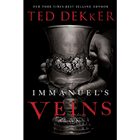
First up: a beautiful and enticing cover jacket which fits the story perfectly. The color, the illustration, everything. An exceptional cover.
The book itself keeps the telltale black and red hardbound cover along with “antique” pages to fit that of an old journal. Preceded with heartfelt commentaries by those who were apparently spiritually moved and somewhat “awakened” by the story, it’s a different and appealing approach to recommending a novel, replacing author endorsements.
The story is told mostly in first person by Toma Nicolescu, young and dashing Russian warrior-supreme and servant of Catherine the Great. Sent politically and strategically to Moldavia to guard and protect a mother and her two daughters at the Cantemir Estate, who happen to be renowned for their beauty and behavior, Toma is accompanied by his fellow warrior and closest friend Alek who is also the modern equivalent to a player. On the final approach to their destination, Toma is warned by a strange fellow and a crow of impending danger but, while intrigued, finds it hard to take him seriously. Near the beginning it seemed there was a hint of some 21st century dialogue which seemed a tad out of place, but it was minimal.
Toma is the ultimate soldier whose sworn allegiance to Catherine makes his intense attraction to the lovely sister Lucine take a backseat to his duty while his friend Alek wastes no time pursuing Lucine’s wild twin sister Natasha.
When certain mysterious Russian guests arrive for a Ball, Toma’s suspicion of the lascivious group eventually leads him to fire a shot, killing one of their group who threatened Alek. This is only the beginning of this group’s infiltration into the lives of Toma, Alek, Natasha, and Lucine. When Alek and Natasha succumb to the group’s strange activities at their Castle Castile, Toma and then Lucine decide to rescue them.
The “rescue” turns into a seduction. The novel is filled with an unearthly sensuality and the brazen display of lusts by the members of the coven of the castle. Irresistible to the so-inclined passions of Alek and Natasha, there will be no “rescuing” their souls. When Toma barely escapes the vacuum of their hypnotic elixirs and lures, his one compromise repels Lucine’s love for him and propels her to become the victim of the king of the castle who desires her for his bride.
Toma discovers for the first time in his life he is no match for these strange and powerful foes, and he learns out of sheer necessity and a new humility there is only one Blood with which life can be restored.
Although touted as a story of redemption, Immanuel’s Veins is really more of an ancient tale of love and lust, life and death, good and evil. And, yes, in the end it becomes redemptive. The interpretation of Nephilim references in scripture always amuses and sometimes annoys me. I find it interesting that many people believe demons can “produce” life when God is the only Author of Life. Demons possess people and occasionally animals, but they do not of their own power produce semen and make babies. Huh-uh. However, those who they infiltrate can do just that. So this tale takes many liberties in its interpretation of such references, but in the overall picture the important part is the real Power in the Blood . . .
. . . And in the source of true Love, the heavenly kind, the real kind, the only kind. The Love who is God. The Justice which is God. The Mercy that exists in God alone. And the Blood which overcomes sin when it flows from Immanuel’s Veins.
For those who love ancient stories that depict sensuality in all its forms, the power of sin and deceit overwhelming the human heart, and the picture of pure evil accomplishing its mission and revealing its nature, Immanuel’s Veins gives you this experience. For those who want the evil contrasted to the good, this novel is a prime example of salvation coming to those who clearly don’t warrant it (and, yes, I realize none of us do) but are allowed to search for it and find it when all other means of hope have been extinguished.
In spite of the speculative premise I will admit the story held my interest. This is largely due to the character of Toma and his clumsy handling of utter desire when his loyalty to duty is challenged. Ted skillfully brings him to the place of giving his life away in order to save the one he loves—a familiar redemptive theme.
Father, the desire is always to honor you. Please continue to bless Ted as he pursues you and seeks after the stories which will bring people to the Cross of Christ, the Blood of the Lamb. In the Name of Jesus, Amen.


 Into the Fire
Leave a reply to Jessica Thomas Cancel reply