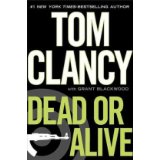
It’s personally amusing that my first read of a Tom Clancy novel turns out to be Dead or Alive which runs 950 pages. Me: the one who exalts long novels and wrote my first one that resulted in 744 pages including the Glossary of Terms. So what did I think of paddling through that many pages? Not too bad.
Dead or Alive is a contemporary thriller in the vein of Vince Flynn stories. With “spooks” and politicians and Islamic terrorists, an independent group of men, including former President Jack Ryan Sr.’s son Jack Junior, search for those terrorists the administration in this novel seek to placate with fancy diplomacy and the reduction and/or replacement of professionals in the CIA and other important places in the government with those who know nothing about what is required to keep this country safe. Sound familiar? Yeah, I thought so too.
This independent group seeks out the best of the Special Ops, Law Enforcement, CIA types who are considering retirement or frustrated with the limitations placed upon them by their government when the enemy has no such guards over their conduct to destroy the USA. Using their contacts and familiarity with other clandestine operatives and organizations in the world, this small group can accomplish what sanctioned operatives sometimes cannot. They operate totally under the radar and only answer to their peers.
As you might expect from a novel this size, the tedium of explanations for different radioactive parts, the voyages to unheard of and desolate places with the outcome predisposed and assured, and the few meandering and vulgar musings of a high-priced call girl, not to mention the probably accurate descriptions of the Arabs’ thoughts who hire the women for their “physical needs”, all lead to some perhaps unnecessary verbiage. This is a secular/general market book so there are no restrictions on language or vulgarity, and all things considered, in those respects it could’ve been worse. Plenty of f-bombs and some lewd imagery and words, so I don’t recommend it for everyone.
An antagonist equivalent to a bin Laden type, the “Emir” cannot be located, and the e-chatter has gone silent which is, according to Jack Jr., a good indicator that something big is in the works and possibly imminent. With Jack’s and another of the group’s geek’s discoveries the team takes off in twos to various parts of the world to capture some of the discovered evil members of the terrorist group (URC) to learn the plans and location of the Emir.
The covert operations are the most entertaining and exciting parts of the story, and the fact that none of them are discovered make the actions that much more fulfilling to read. Realistic in its portrayal of two kinds/sides of politics and government as well as the dangerous and sometimes tragic world of covert operations bring this contemporary story to life.
Writing-wise I found the use of nicknames and real names used for the same characters confusing at times in keeping track of who was who. Small thing really, but being unfamiliar with them kept me off-balance and stopping to reassess their identities. The POV slippages and opting into omniscient will no doubt bother some readers—though probably only those who write.
For those political/spy thriller readers who appreciate a lot of technical data streamed through stories, this is the book for you.
I’ll tell you the part of the novel I liked the least. In fact I’ll quote it for you, stated by one of the primary characters John Clark, a go-to guy in Special Ops. In putting his thoughts together with a few other incidents and nuances in the novel, I’m not sure if this is just the character’s thinking or if this is Tom Clancy’s opinion. Frankly, it bothered me.
***SPOILER ALERT***
Clark had never met a bad Saudi. There were a few he knew well from his life in the CIA, people from whom he’d learned the language. They’d all been religious, part of the conservative Wahhabi branch of Sunni Islam. Not unlike Southern Baptists in the thoroughness of their devotion. That was fine with him. He’d been to a mosque once and watched the exercise of the religion, careful to stay inconspicuously in the back—it had been a language lesson, for the most part, but the sincerity of their religious beliefs was evident. He’d talked religion with his Saudi friends and found nothing the least bit objectionable in it. Saudis were hard to make as close friends, but a true Saudi friend would step in front of the bullet for you. Their religion’s rules on such things as hospitality were admirable indeed. And Islam prohibited racism, something Christianity had unfortunately left out.
***SPOILER CONCLUDED***
Obviously, “John Clark” or possibly Tom Clancy has no clue what Christianity truly is or what the word of God has to say about racism. Not to be naïve about seeing prejudice in the church. Nevertheless: prejudice is not a part of Christianity; it’s a part of humanity.
Written in partnership with U.S. Navy veteran Grant Blackwood who also co-authored two novels with Clive Cussler and authored his own Briggs Tanner Series, Dead or Alive by Tom Clancy will provide a detailed story about what it takes by covert operatives to defeat a powerful, persistent, and remarkably patient enemy.
Father, I have no idea what Tom Clancy’s “religious” status is, but I know the only thing that matters in this world and the next is a relationship with Jesus. I pray that Tom would have one and that you would continue to enlighten his writing. In the Name of Jesus, Amen.


 Into the Fire
Leave a reply to Jessica Thomas Cancel reply