Into the Fire

Passionate thoughts about the world of writing and the Power of God


Over the years here on this blog we've examined all kinds of writing topics. I've asked authors and other professionals in the industry to define "Christian Fiction". I've asked the question regarding what different authors and insiders in the publishing industry desire to see change in Christian Fiction. Many answered anonymously because they held some trepidation about the overall responses from their "bosses" or colleagues in the biz. From the techniques, styles, POVs, voices, to even adverbs: we've talked about it here.

We've argued at times over who the "average reader" is, why I think it's possible writers can make lousy reviewers, and who defines quality in the art of writing.

Now over the last two days a romance novel has dredged up the conflict of what "should" and "shouldn't" be included in Christian Fiction. Again.

So I'm going to state my opinion on this matter (again), and I hope you'll have the time to contribute yours. The reason for this is because the public forum presented by the various online booksellers or social media for reviewing books of all kinds also gives voice to readers who write shrill, daggered, mean-spirited, and close-minded opinions of Christian novels. Hey, free speech, baby. Just because it's "free" doesn't make it right or well done. I'm going to address the Christian reviewers here.

In reality the only ones in publishing who decide the shoulds and should nots are the publishers. Most of them give a mission statement or have some sort of protocol for whatever they decide to publish. With most Christian publishers, they call it a mission statement. No matter how it's worded, chances are if they slip a story in there which contains the words or apparently a few of the activities mentioned in Becky Wade's novel, look out. The Christian Fiction Police are on the job and ready to arrest whoever's responsible for disappointing their senses of right and wrong, and what should be included in Christian Fiction and what should not according to their particular judgments, assessments, and evaluations of spiritual literature.
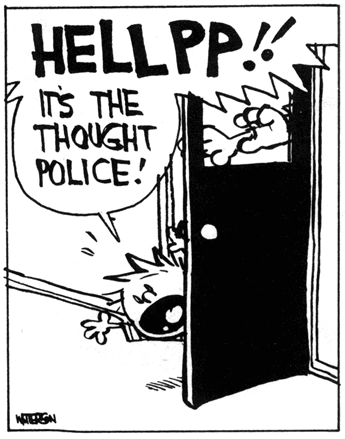
                 Thought

I'm weary of this brood. First of all it's not the decision of the reader what should or shouldn't be included in any novel. Although they're the ones who choose to purchase – or possibly receive a copy free for review – no one insists they finish a story they start and no one demands they enjoy it. I wish I had a dollar for every novel I didn't like. However, if I'm not reading it for review, I'll just file it under "a waste of time" and forget about it. If I'm obligated to review a novel I don't like, I'll certainly give my reasons but definitely not from the standpoint of determining its "fitness" for Christian Fiction. That ship has sailed, and I wish those who complain about the contents of novels "offending" them would dismount their high horses and just write that the story didn't meet their standards. The criticisms of Becky Wade's My Stubborn Heart appeared so graceless and shallow when the readers resorted to citing the poker playing, Yoga, word choices, and a casual date as unacceptable for Christian novels. This is precisely where the stereotypical, legalistic, holier-than-thou parodies originate. Their words remind me of "resounding gongs" and "clanging cymbals".

Understand that everyone's opinion can matter but doesn't necessarily. Reviewing novels quite honestly can reveal our weaknesses as individuals, as writers, and as Christians. The shoulds and shouldn'ts people invariably expose things about themselves better left hidden – or preferably addressed between them and God.

Thank you, Jesus. You gave it all for all of us. May we honor you with our words, thoughts, actions, and prayers. In the Name of Jesus, Amen.   

Posted in

7 responses to “Shoulds and Shouldn’ts”

  1. Tim George Avatar

    This and the last article are two that need to be read by readers and writers alike! As much as most of us as writers would like to blame publishers for such things the reality is that they are in to make a profit. They know their target audience (or at least think they do) and are scared to death to ruffle the sensibilities of that audience. I’m really not sure what the answer to this dilemma is.

    Like

  2. Nicole Avatar

    I’m not sure there IS an answer, Tim. What I would hope to happen – but apparently will not – is that readers who decide to review novels would examine why they’re so “offended” and ask themselves if it truly has merit. Being “offended” by a story seems absurd to me. It’s not required reading, the reader can stop reading, and no one can make a person like it, but to pick apart a story because of a friendly poker game, etc., seems shallow, trivial, and seriously judgmental.
    For publishers, who knows? Create an imprint for these stories which dare to cross an invisible line but remain solid “Christian Fiction”? (At least then my work might find a home.)
    Thanks for taking the time to contribute to this discussion, Tim.

    Like

  3. Becky Wade Avatar

    There are tea parties in the book. Did no one take offense to the tea parties??!! 🙂
    I accept that some of the content of my book may offend some readers. The truth is that my book won’t be for everyone. If I tried to write a book to please everyone, I believe the product would be so lukewarm and sanitized that no one (least of all me) would enjoy it. So, ultimately, I have to write the book I feel led to write.
    I will say that my editor and I weighed every single word in the novel with care and thought. I cringe to think what my critics would have said if I’d left in all the words I took out or softened. !!

    Like

  4. Nicole Avatar

    Becky, there is really no way anything in your novel “SHOULD” have offended anyone. Seriously.
    I’m quite proud of Bethany House. As ridiculous as it sounds for what little there is to “complain” about, it was a gutsy move for them.
    You keep writing your heart, girl. These reviewers need to go back to their Amish novels which quite frankly offend me.

    Like

  5. Becky Wade Avatar

    LOL!!!
    Btw, I’m quite proud of Bethany House, too. They were willing to step out there with a book that’s different. By an author with a frank writing voice. About characters who are imperfect – redeemed only by a perfect God.
    Thanks for the really interesting posts and good food for thought.

    Like

  6. Sally Bradley Avatar

    Nicole, I’m going to be the weird person who didn’t care for most of the things people complained about but loved the book anyway. Just loved it.
    I’m like you–Halloween, see ya. That surprised me a bit, but hey, I know all Christians don’t see eye to eye on that. I personally despise the word boobs. Hate it. With a passion. But again, I realize not everyone is that way. Will I use that word in my books? Never. Unless someone paid me–and maybe we were talking about the tv . . . who am I kidding? I hate the word.
    I read a few other reviews and really was quite surprised how completely bothered they were by these things. In many cases, I would agree with those reviewers that I didn’t like those items, but to expect everyone to believe and think and behave in the same way that I do is just unrealistic — whether we think those things are right or wrong.
    Here’s what I think those reviews will do. As painful as they must have been to read, I think in the end, they’ll be great. People who would be offended by those words or topics will not buy the book. So less hate mail for Becky and Bethany House. 😀 Yay!
    But the people who find those things refreshing because it’s reality–those negative reviews are going to send them to Amazon, B&N, bookstores, wherever. Frankly, I think it’ll end up being great advertising that’ll draw her readers to her. In this case, the specificity actually helps.

    Like

  7. Nicole Avatar

    I’m so with you on the “boobs” word, Sally. But like you, so what? I also hate the word “pi–“. With a passion. But so what? Many people do talk like this and see nothing wrong with those words. (The p-word was used by a non-Christian in the book.)
    You make an important point about dividing the readership. I think I agree with you there. It’s just so frustrating to read what seems absolutely petty in content. The book didn’t proselytize for any of those so-called offensive things, so really what is the problem?

    Like

Leave a comment