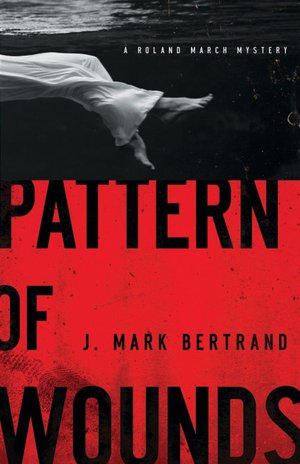
The Christy Awards are coming up on July 16th in Orlando, Florida. First of all, will you be attending since Pattern of Wounds is nominated in the Suspense category? Now for a more difficult question: do you think they should add an additional category for Thrillers since this isn’t the first time novels which don’t easily fit into the Suspense category have been thrown together with those that do?
JMB:
I attended ICRS, where the Christy Award ceremony is held, last summer, and was hoping to get there this year, too––especially given the fact that Pattern of Wounds is a finalist––but I couldn’t make the schedule work, so the always-excellent live blog will have to do. Since I had the privilege of being a Christy judge for a couple of years some time ago, I know a little bit about the process. My guess is, if there were enough novels like mine to justify a separate category, they’d create one. But there’s not a lot of serious crime fiction in the evangelical market, and it’s not too much of a stretch to move it under the suspense banner.
For most authors it’s difficult to reflect on a past novel after releasing another (Nothing to Hide), but is there anything unique you’d care to share about the writing of Pattern of Wounds or personal feelings about that particular story?
JMB:
None of my books are what they appear to be. On the surface, you see this CSI forensic thing happening, a convention genre trope, but if you read closely you find that the assumptions are being undermined. In Pattern of Wounds, the trope in question is the serial killer story. I hate them. Of course, they’re perfect for the novel, since you can unveil a series of ever-more-ghastly, ever-more-inventive murders, but what the serial killer trope says about our concept of evil is something else. That’s the question I wanted to explore.
Pattern is my “problem of evil” book. I’m passionate about it, so it’s a pleasure to see the book honored by the Christy judges.
How do you feel about awards for writing?
JMB:
The trick is to enjoy the recognition without letting it influence you. I’m not indifferent to the recognition. There’s a part of me that really craves it. As a novelist, you’re a loner much of the time, unsure whether anybody really understands or sympathizes with what you’re trying to do. So it’s nice to get some confirmation. But I think writing awards are a lot like medals for heroism––wonderful to receive, but not something to chase after. Chasing after them is risky.
As you know the marketing and publicity people love to label everything, but authors don’t always align with their assessments. Give me your description of your Roland March Mystery Series.
JMB:
It’s a series of crime novels, specifically detective stories, written by a man interested in a bunch of murky questions which are ultimately theological. If books published by evangelical houses weren’t tucked away in the inspirational section––a rather inappropriate heading to file novels like this under––they’d go nicely on the same shelf as James Lee Burke, Michael Connelly, and Ian Rankin. In fact, it was reading Burke that convinced me the crime novel could be an ideal form for exploring the kind of themes I’m obsessed with.
Roland March is a damaged man with a lot of submerged pain. Is there anyone in particular after whom he was fashioned? In your mind how did he become who he is initially?
JMB:
If you read the three books that have been published along with the excerpts from The Kingwood Killing posted at jmarkbertrand.com, you can see how March went from a promising, idealistic police officer to the mess he is today. The mess is good, if you ask me. It shows he hasn’t been able to do this kind of work so long without being altered. I despise the heroes of commercial fiction who might as well have been snipped from a Sears catalog, upright and unscathed. They’re interchangeable. I’m not interested in reading about them, or writing about them. March isn’t based on any one person. Perhaps he’s an alter ego, heavily disguised.
An actor to play Roland March? Soundtrack artist to do the scores? Director?
JMB:
If you took Philippe Noiret around the time he did Coup de Torchon, looking kind of scruffy and put upon, stuck him in a suit and put a gun in his hand, I’d be happy with that. I’d love a soundtrack by Michael Nyman or Philip Glass––though I’m sure March himself would prefer Johnny Cash. Maybe Anthony Minghella as director, since he was so good at adapting books. If I had to use living actors and directors, I’m not even sure where to begin.
The main thing, to me, would be capturing the mood of the books. People think of Texas and reach for hyperbole and ten gallon hats. That’s not what these books are at all.
I’d better stop thinking about it …
Your research for these novels?
JMB:
Living, mostly. I’m not being flippant here. A lot of well-researched books ring false because they don’t capture the truth about life. I try to get the details right, but trust me, it’s not about the details. The facts in fiction are just part of the illusion. I’ve always been fascinated by crime and detection, so I don’t have to reach far to get the facts right.
Mark, anyone who’s read your novels, visited your websites over the years, or has had the pleasure of speaking to you in person recognizes the quality of your talent, the depth of your intelligence, and the gracious nature of your personality. In evaluating your writing, what do you consider your greatest strength?
JMB:
Thank you very much. I believe very strongly in what I’m doing, so consequently, I’m not at all objective. My greatest strength is also my greatest shortcoming: subtlety. I’m content not to spell things out. I write for those who have ears to hear, eyes to see, etc., which takes some discipline, because people have to look closely to see what’s going on.
Considering your MFA, how do you evaluate the so-called rules of writing common to Christian fiction?
JMB:
To answer that, I have to break a taboo of today’s Christian fiction and get preachy. Feel free to skip to the next question.
Still with me? All right, then.
Let me channel Mark Noll and make a pronouncement: “The problem with the evangelical novel is that there is no evangelical novel.” Someone can be superficially Christian, but not deeply so. On the other hand, someone can be deeply Christian, but not superficially so. Most evangelical fiction falls into the former category as a result of the formula by which it was manufactured, which joins the conventions of late twentieth century commercial writing with a watered down version of Joseph Campbell’s hero journey. The “spiritual content” calls a lot of attention to itself in the way a boisterous hypocrite might, but under the surface there is nothing especially Christian about the ideas the story explores.
Walker Percy called postmodernity the “theorist-consumer age,” and in this sense I’d say evangelical fiction is quite postmodern. It justifies itself with an appeal to the consumer––this is what readers want––while at the same time throwing mud at the deeply Christian writing that went before and is trying to go again. The idea is, the consumer is a christened consumer, therefore what she wants must be Christian. (But would you attend a church where the preacher only tells you what you want to hear? If not, then why would you hobble your reading with such provision?)
Now when people talk about Christian fiction, there are typically two trends: the old-style preachy stuff and the new-style soft-pedaling stuff. I’d lump them both together as two sides of the same coin, like liberalism and fundamentalism. They’re at odds, but they share the same underlying assumptions. Either you get beat over the head with the message, or there’s not one.
Writers like me represent a third way. I’m an author with theological concerns who wants to work out certain big themes in fiction. I’m not interested in Campbell’s mythos as much as the Bible’s. High-minded Christians sometimes lament the end of the great literary tradition embodied in authors like Mauriac, Waugh, Graham Greene, Flannery O’Connor and Walker Percy. That’s the lineage with which I identify and from which I draw inspiration. Unfortunately, these high-minded readers have learned not to expect this sort of writing from evangelical houses. They’re the people who tell me they love my work, they just wish somebody else published it.
But frankly, my work illustrates a truth, which is this: within the larger stream of “evangelical fiction,” there are authors doing things differently, pursuing that older line of enquiry. The problem is, the market tends to punish you for this kind of thing. Maybe it comes down hard, maybe it takes no notice at all.
Now I realize this doesn’t touch precisely on the “rules,” but I think it does speak to the foundation underlying the rules.
(I agree, Mark.)
Publishing is in flux with the e-reader “revolution”. Do you have an opinion on the state of publishing?
JMB:
The good news is, it’s easier than ever to publish and distribute books. The bad news is, it’s easier than ever to publish and distribute books. This is a golden age for the author-as-entrepreneur and a not-so-golden age for the author-as-artist. People who are better at writing books than writing ad copy still need marketing support and intelligent publishers to find their audience. Things will be better, though. Publishers will emerge who understand how to do their work in the new environment. This will hurt book publishing the way Gutenberg hurt scribal copying. In the end, a new balance will emerge.
J. Mark Bertrand, who is he really?
JMB:
He’s a very flawed, over-educated, insecure, egotistical, bearded person in tortoiseshell glasses, an obsessive craftsman, enthralled by nostalgia, tragedy, and minor keys, sometimes sincere, sometimes bluffing, sometimes sincerely bluffing. With Hamlet he sees that time is out of joint, with Scaramouche that the world is mad, and his nostrils are filled with what C. S. Lewis once called “the stench of the holy.”
I’ve had the privilege and pleasure of speaking with you and meeting your lovely wife Laurie. Is Laurie your first reader? Does she influence your work in any way?
JMB:
Laurie allows my work to continue, which is a significant influence. She has always been supportive of this quixotic journey. Sometimes she’s a first reader. Sometimes she has things read aloud to her while she’s in the middle of something more interesting.
There has been a lot of discussion on the restrictions placed on writers of novels in the Christian publishing industry. Do you feel the restrictions create any dilemmas for writers or have they affected your work at all at Bethany House?
JMB:
The thing about the world of evangelical publishing is that, like an adolescent boy, it’s fixated on sex and language. Either there’s too much of it, or there’s not enough of it. When we mature, we’ll defer to authors on such matters. I’m with Walker Percy when he says “the only rule I follow is that anything is allowed that serves the artistic purpose of the novel.” So long as the debate rages, artistic purposes that don’t center on sex and language are prone to be overlooked. The Song of Solomon would have a hard time being published in CBA, sure. But so would the book of Ecclesiastes.
What is your relationship with your editor and has it been the same individual for all three novels?
David Long acquired the books and was my editor throughout. He and my line editor, Luke Hinrichs, were supportive throughout the process, offering good feedback. Dave has great taste in fiction, is a novelist himself, and is willing to take risks when the quality is there. Bethany House has a number of strengths, but its best asset by far is editorial.
Your article (http://byfaithonline.com/writing-about-reprobation-2/) gave an extensive examination of noir literature and film. Do you classify your Roland March Mystery Series as fitting into your description of American noir?
JMB:
I’m not a noir writer in the literal sense––it’s not about being faithful to the code for me, or dabbling in pastiche. Rather, I claim noir as one of my influences, especially in its honesty with regard to corruption. For one kind of theologically-minded author, the rational puzzle stories of the Golden Age remain appealing. But I’m not of Aquinas so much as Calvin.
Current WIP? What can you tell your devoted readers?
JMB:
I never give details about what I’m working on if I can help it. Let’s just say, I’m writing crime fiction of one sort or another, and while the next book won’t be about Roland March, I hope to get back to him in time. If enough readers latch onto him, he’ll be back.
As a Christian who writes, the faith thread runs like a thin line through all three Roland March novels. You primarily introduced it through a young pastor and his wife in Back on Murder. You’ve never degraded it even when March punches some holes in the clichés. What is your desire for readers from your Christian audience?
JMB:
March tends to know his Bible better than his evangelical critics, which means the platitudes never work with him. To me, there’s a value in seeing the world through his eyes––indeed, from seeing the church through his eyes. The vision of the church in Christian fiction is rarely prophetic, only affirming. March’s astringent observations may be just what the institution needs.
(Again, I agree.)
You recently revealed in an interview that you wanted “deep readers” for your audience. Do you think this is a common desire shared with Christian publishers?
JMB:
Publishers are a varied lot, just like authors. What we all have in common is the desire to sell books. Most of us also want to be proud of the books we sell. Given the choice between books you can be proud of but can’t sell and books you can sell but can’t be proud of, I’d like to think most of us would prefer the former. Obviously, most publishers feel they have to dabble in the latter, too, just to make ends meet. A lot of writers do, too. There are bills to pay, and so on. Given that fact, you can imagine what a balm, what a consolation, what an absolute delight it is to hear from a single deep reader, who didn’t just skim your book but took its full measure. When those readers become enthusiastic and start recommending your work, that’s bliss.
Your final thoughts on the industry as a whole?
The important thing––indeed, the only thing––is the books. I’ve written three novels that aren’t like anything else in the industry, and they’re in print. If you can say that much, you have nothing to complain about. Writing is what I love, and all I want out of life is to keep doing it. The only way I can think of to make sure of that is to do it well and with all my heart.
Father, thank you for my friend Mark. Thank you for his love for you and his desire to wrestle the tough issues of our faith. You're always up for a good wrestle, Lord. I pray your continued blessings on him and Laurie, your divine protection, your multiple inspirations for the craft which he masters and in which he glorifies your touch on his life. I pray for many stories to tell, designed just for him. In the Name of Jesus, Amen.


 Into the Fire
Leave a reply to Jason Joyner Cancel reply