Into the Fire

Passionate thoughts about the world of writing and the Power of God

     Detail-7455911

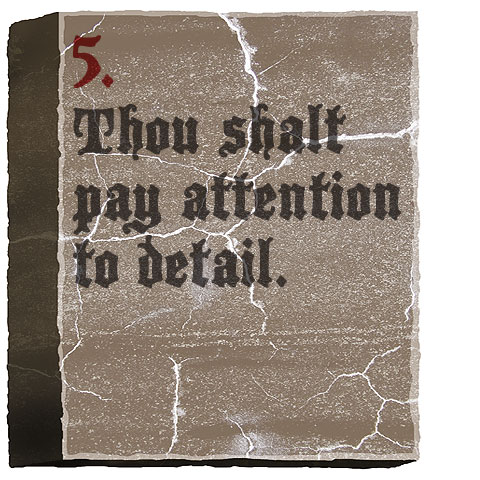
You've heard the expression "the devil's in the details", and it's up to you which translation of that little phrase you care to use or understand. When I'm reading a novel, I love details, but even I will admit there can be too many or too much.

If you've ever read any of Tom Morrisey's novels, you know that Tom employs many details. In my favorite book of his, In High Places, Tom uses his rock climbing knowledge with all the proper terms and descriptions of the equipment and experience. He never talks down to the reader. I guess he figures if the reader doesn't know or can't grasp the term(s) he uses, he/she will look it up – which I had to do a couple of times. In my opinion Tom Morrisey uses just the right amount of focused detail to convey authenticity in his stories.

Some authors interrupt their stories to explain detailed information, making what has been narrative morphing to conversational. When the writing changes from the organic deliverance of information (i.e. via dialogue) to the recitation of definitions, the details become a hindrance to the story. If the detailed description goes on too long, the continuity of the story succumbs to potentially losing or boring the reader.

Some readers don't want to read about characters' appearances. I do, providing the description of those details isn't cliché. It takes some finesse to do this because, after all, there are only so many shades of blue, so many colors of hair, so many types of builds, and you get my drift. To set individual characters apart, an author has to make those details unique as the character who "wears" them. Sometimes it's another character's point of view making the observation of those details and it's reasonable to assume some of those observations might be typical and clichéd.

What kind of details do you enjoy reading, and can you think of an author who does "details" well?


Father, you gift us all differently according to your design and pleasure. Thank you for it all and for viewing each of us equally. In the Name of Jesus, Amen.   

Posted in

7 responses to “Details”

  1. Brenda Jackson Avatar
    Brenda Jackson

    How to use detail is indeed very tricky. And another area where “rules” hinder the writer. As I was reading your post I was thinking of Vince Flynn. He wrote books that covered a very broad scope. By absolute necessity, he had to spend several paragraphs at a time explaining international relations, the complex methods for fighting the war on terror, etc. In the case of a story like this with a broad scope, if he’d tried to accomplish the same task by integrating it through dialogue, he would’ve had a 3000 page tome. I don’t mind that he spends time telling me things because I don’t work for the CIA and I’m not hip to the international scene. I want to know everything he can, yes, dare I say it, “tell” me.
    I’m also reminded of a really solid story I’ve been critiquing for someone that also is a story that has a very broad scope and is set in country(ies) I know next to nothing about. In this author’s case, the struggle their manuscript has is finding a clear and concise way to explain those international details. This is no easy task given the differences in politics, culture, etc. in a cluster of countries that are close together. Unfortunately, I would suspect that this author has been previously hammered with the “DON’T TELL! DON’T TELL!” advice, because while the book is a very interesting read, keeping a handle on the countries, politics, and cultures is not very clear.
    It is my hope for that author that they will find someone to mentor them and help them take that story to the next level. Someone who can help them tell not only the character-level personal, but also the broad scope international implications in a clear way the reader can understand and, most importantly, learn from.
    As an addendum to that–details are tricky because in international incidents, things are unfolding for which clear explanations are not available for several years down the road. Navigating these things is not easy for the writer.

    Like

  2. BK Jackson Avatar
    BK Jackson

    An area where I like to read detail is about setting as character. Growing up reading and still preferring westerns, setting is crucial. Zane Grey was a master at setting although even I, in this ADD age we live in, probably couldn’t read that much setting detail any more.
    Surprisingly, not many writers are that skilled in the use of setting. Even as much as I love setting, I find that to be one of my weak areas too. But when you find an author who does it well, it adds a whole lot of quality to the story.

    Like

  3. Nicole Petrino-Salter Avatar

    Vince Flynn does it well, and he doesn’t talk down to the reader either. There is nothing I don’t like about his novels except for Mitch’s girlfriend/wife – hated her. And “telling” must be accomplished in some capacity. When words can “show” better than tell, necessary. Sometimes telling must be done to reveal significant information.

    Like

  4. Nicole Petrino-Salter Avatar

    Doing it well is key to it all. I love setting too unless it’s so precise I lose the element of imagination.

    Like

  5. Debra Avatar
    Debra

    Ditto to your words, Nicole. I also enjoy the description of a character’s appearance, providing the description of those details isn’t cliche. It is interesting when it comes from another character’s viewpoint. You do this well.

    Like

  6. Brenda S Anderson Avatar

    Use (overuse) of description, like everything else in storytelling, boils down to reader subjectivity. In today’s reading/writing world, we’re told readers want to get right to t he point without a lot of description, but description told in the right way (also subjective) enhances the story.
    One of my favorite authors, Laura Frantz, is a painter of images. I’d read her books even if they didn’t have a story because I enjoy her prose & word pictures so much.
    As for character descriptions, I do like them in modern storytelling. What I don’t like is when the cover image doesn’t match the description.

    Like

  7. Nicole Petrino-Salter Avatar

    Thanks, Debra. Avoiding clichés is tough because we all know those clichés are based in actuality.
    And totally agree, Bren. Sometimes those covers ruin the image. Not matching the character in the pages is a huge no-no in my opinion. And subjectivity overrides it all, doesn’t it?

    Like

Leave a reply to BK Jackson Cancel reply