Into the Fire

Passionate thoughts about the world of writing and the Power of God

  •  

    The season is ending for a lot of series television before the short summer seasonal programs begin. Some of the programs will not return in the fall while others have already received their guarantees.


    Cliffhangers, deaths of favorite characters, relationships abruptly ending while others are surprisingly indulged—or at least hinted at. Ah, the perils of series television and final episodes. May is a difficult month for devoted fans—of which I am one. I love television. A terrific medium.


    My favorites? NCIS; NCIS Los Angeles; Bones; all the CSIs; Criminal Minds; Hawaii Five-0; Blue Bloods. I know some characters will not return—they’re being killed off. I won’t be happy no doubt.


    You like TV?


    Father, thank you for the various forms of creativity and visual recreation. Use it to inspire me, Lord. Help me to see through your eyes. In the Name of Jesus, Amen.

  •  

    Recently on a “Bones” episode, Dr. Brennan discussed objectivity with the night watchman Micah, telling him she feared she was unable to maintain her objectivity in the particular case she was investigating. Micah explained that he heard in a lecture that there could be no real objectivity because of the different influences occurring in people’s lives. This of course was striking information to the emotionally challenged forensic anthropologist who prides herself on rational reactions to every situation.


    Interesting concept: objectivity. I confess there are very few times or issues in my life when I can assess things objectively. I react emotionally to most circumstances—sometimes to a fault and unnecessarily. For me to be “objective”, I have to maintain no stake in the matter. In other words the assessment of the matter or thing doesn’t hold any sway one way or the other. And, I’m afraid, if that’s the case, usually I could care less.


    In writing and reading I’m not objective. If I detest a novel, I can tell you why. If I dislike a novel, I can also tell you why. Usually in these two instances, it’s for a variety of reasons including the writing itself. Objectively speaking, a novelist can write proper fiction that is stylistically correct and follows acceptable writing criteria for genre, characterization, and plotting, but that doesn’t guarantee I’ll like it. Especially if all the proper usage of language skills churns out a formulaic story with clean as a whistle unimaginative prose. No thank you. Objectively speaking, I could say the writing is “correct”, but beyond that the story presents nothing to captivate me—and I tend to do that if I must give a review.  


    I know some writers can set aside their preferences to effectively evaluate not only the work of others but their own. They eagerly seek respected friends and/or professionals to go over their efforts with severe red penmanship and welcome that input. These writers have acquired good filters and discern the good from the bad advice, incorporating what they find to be sound. Their ability to be objective ranks fairly high on the meter.


    Relying on the current rules of writing for setting a standard for the objective assessment of a writer’s work can only apply as a contemporary measure since many of the classics do not demonstrate these rules—in fact they defy them. Contemporary writers assess their value in their personal work and write accordingly. Objectively speaking, the current rules presented by professionals speak to their preferences for publishing and perhaps reading. The exceptions to the rules in published works confound writers who aim to stick to them in seeking publication.


    Most writers as readers evaluate writing, some moreso than others. Voice and style play a large role in what writers as readers will accept or enjoy. Some writers carry a strict standard by which to measure others’ works. Other writers adhere to a loose code and a liberal standard for judging the work of others if it falls within a favored genre. If not: look out.


    So what about you? Do you feel you can be objective when assessing a novel you’ve read? What is your standard for judging someone else’s work? Do you apply the same standard to your own?


    (Just for trivia’s sake: this is not a response to Mike Duran’s post. I intended to post this yesterday but got side-tracked with “Different . . .”)


    Father, you provided the objective but left it to us to be subjective in our acceptance of the sacrifice of your Son. All who come through Jesus are welcome. Thank you for the rescue. In the Name of Jesus, Amen. 

  •  

    Some people don’t want to be “different”, they just are. Others think they want to be different, but they mesh with a “different” crowd and end up being the same as them. What is different anyway? I suppose it depends on what you’re discussing. Fashion? Mannerisms? Writing? What qualifies as different in particular situations?


    I finally indulged my desire to be different in high school. Believe me, I wasn’t that different, but I got to assert myself in some of my fashion choices. I think I was the first one to wear knee-high boots to school in my sophomore year. Really. Black leather knee high boots. I know that hardly seems “different” now, but then it showed a little chutzpah. Later in my post-school, pre-Europe days, I bought those amazing black calfskin leather boots I saw in “Harper’s Bazaar” and “Vogue” magazines that went all the way up to the top of my legs. They had to be worn with a belt under my dresses to keep them optimally up. Aaahh, those were the days, my friends.


    So. How ‘bout writing? Honestly, I didn’t think I was doing anything different, other than writing my first novel about horse racing Hope Of Glory (yes, I capitalized the O in of on purpose; perhaps that was different)—a comprehensive look at American racing in the 80s since the great Dick Francis captured British and European horse racing and wrote suspenseful stories. After that first book, I began a sequel but abandoned it to write my second novel (The Famous One) best described as a fictional biography about a kid who gets discovered singing a blues song in a bar and goes on to become a movie star. Polar opposites these two novels not only in subject matter but style. The first one was a collage of characters, horses, and the day-to-day account of one season of racing at a middle echelon racetrack much like the now defunct Longacres. Disregarding the numerous writing mistakes, and I do mean numerous, the story was authentic. The second novel used omniscient POV to start the story from the beginning of the protagonist’s life and eventually merged into third person. What these two stories have in common is my voice and the love story factor which is elemental to the plots of each.


    The next five completed books and two of the three I’ve started are contemporary love stories, heavy on the romance. I think the thing that makes them different from typical category romance is they tackle sexual attraction and the passion that ensues with the appropriate attention it deserves—from the lost and found POVs. In other words: from both the godless and godly POVs. The collision of those views can separate and define what love means to individuals.


    The exploration of sexual attraction with a spiritual overlay tends to make these stories different.


    Those of you who visit here know I’m a rebel when it comes to rules. Rules that make no sense other than to stifle creativity or unique styles bug me. I understand their value when introducing young writers to the precision of words and the art of craft, but beyond that initial understanding of their potential importance, that value often declines when interfering with voice and styles to produce formulaic writing. I agree a writer should know them well before planting their fingers on keyboards to disregard them. The Chicago Manual of Style which is commonly used for acceptable presentation/formatting of literature can be a bit restrictive, and some of it concerning numerical notations (i.e. spell out the numbers under ten), capitalizations of endearments (i.e. “What do you think, Darling?”), and when it’s okay to capitalize Mom and Dad and when it’s not (i.e. her dad said) seems downright silly. 


    It isn’t about being “different” when I devalue “the rules of writing”. It’s to accentuate the need for freedom in accomplished writing in order to avoid the sameness of much of the current fare. We’ve talked about formulaic fiction and giving readers credit, but we’ve also discussed the conundrum that some readers enjoy the formula while considering the writing to be inconsequential.


    Much of what writers do is done to satisfy ourselves. To improve. To excel. To emulate the skills of favorites. To diversify. To find appeal. To write something that will find its way to even minimal acclaim. To share something of value. To hope to touch someone else with the intimacy of story. And to be a little bit different—at least some of us hope for that.


    Father, thank you for your unique designs. Your giant love for your creation. Thank you for my life, Lord. You know I wish I’d found you sooner, but my stubborn ways kept me distant. I know you’ve forgiven me for those days I can’t change. Help me to change those things I can. In the Name of Jesus, Amen. 

  •  

    But the man who loves God is known by God.

    1 Corinthians 8:3 (NIV)

  •  

    Contemporary Romance


    Blood Ransom

    by Lisa Harris (Zondervan)


    Indivisible*

    by Kristin Heitzmann (WaterBrook Press)


    Sworn to Protect

    by DiAnn Mills (Tyndale House Publishers)


    Contemporary Series, Sequels, and Novellas


    The Reluctant Prophet*

    by Nancy Rue (David C. Cook)


    The Thorn

    by Beverly Lewis (Bethany House Publishers,
    a division of Baker Publishing Group)


    The Waiting

    by Suzanne Woods Fisher (Revell Books, a division of Baker Publishing Group)


    Contemporary Standalone


    Almost Heaven*

    by Chris Fabry (Tyndale House Publishers)


    Lady in Waiting

    by Susan Meissner (WaterBrook Press)


    A Season of Miracles*

    by Rusty Whitener (Kregel Publications)


    First Novel


    Crossing Oceans*

    by Gina Holmes (Tyndale House Publishers)


    Heartless

    by Anne Elisabeth Stengl (Bethany House Publishers, a division of Baker Publishing Group)


    A Season of Miracles*

    by Rusty Whitener (Kregel Publications)


    Historical


    Chosen: The Lost Diaries of Queen Esther

    by Ginger Garrett (David C. Cook)


    For Time & Eternity

    by Allison Pitman (Tyndale House Publishers)


    While We’re Far Apart

    by Lynn Austin (Bethany House Publishers, a division of Baker Publishing Group)


    Historical Romance


    The Girl in the Gatehouse

    by Julie Klassen (Bethany House, a division of Baker Publishing Group)


    She Walks in Beauty

    by Siri Mitchell (Bethany House Publishers, a division of Baker Publishing Group)


    Within My Heart

    by Tamera Alexander (Bethany House Publishers, a division of Baker Publishing Group)


    Suspense 


    The Bishop*

    by Steven James (Revell Books, a division of Baker Publishing Group)


    The Bride Collector

    by Ted Dekker (Center Street)


    Predator

    by Terri Blackstock (Zondervan)


    Visionary


    To Darkness Fled

    by Jill Williamson (Marcher Lord Press)


    Konig’s Fire

    by Marc Schooley (Marcher Lord Press)


    The Last Christian

    by David Gregory (WaterBrook Press)


    Young Adult


    The Charlatan’s Boy

    by Jonathan Rogers (WaterBrook Press)


    The Healer’s Apprentice

    by Melanie Dickerson (Zondervan)


    Motorcycles, Sushi, and One Strange Book

    by Nancy Rue (Zondervan)


    *I've read these.

    (I think it's important to note that these awards have a specific criteria for judging, and they must be nominated with a fee by their publishers.)

    http://www.christyawards.com/ca_new/index.php?option=com_content&view=category&layout=blog&id=40&Itemid=57


    Lord, thank you for each one who writes for your glory. Come close to all who desire to serve you with their writing and let them/us know you are with them/us every step of the way. In the Name of Jesus, Amen.
  •  

    Fiction over non-fiction. Always.

    Michael over Mike.

    Anything over Fantasy and Bonnet Books and most Historicals.

    Nicole over Nichole. Please.

    Sun over snow.

    Beach over mountains.

    Australia over the Far East.

    My dad's spaghetti over anyone else's. I miss you, Dad.

    My mom's cherry pie over anyone else's. I miss you, Mom.


    Once again, God, thank you for the incalculable blessings, mercy, and grace in my life. Jesus, thank you for rescuing me. Holy Spirit, keep allowing me to hear your voice. In the Name of Jesus, Amen.


  •  

    If money was no objective . . .

    If you could do anything you wanted to do . . .

    If you could go anywhere in the world . . .

    If you could have any skill . . .

    What?


    Father, thank you for all you've given me. You've been so gracious to me. May I never forget apart from you, I can do nothing. In the Name of Jesus, Amen.


  •  

    No, it doesn't mean that terrorism will stop. What it does mean is that the incredible elite forces and the CIA and the American military are courageous, brave, and tenacious. It means that justice will be served to those who violate human decency and kill people who have nothing to do with their fanatical causes. It means that in spite of those who demean this country within this country, the USA is still a force, is still a country to be reckoned with, and it will still pursue those who've assaulted its people.

    We are one nation, under God, and we have not forgotten the grace bestowed upon us. Our freedom reigns because of the Almighty Lord, and we will not succumb to the whims of the feeble, the wars of the extremists, or the plots of politicians to turn us into what we were never meant to be.

    Thank you, SEAL TEAM SIX! And to all who participated, we honor your efforts to make this world a better place. God bless you and God bless the USA!


    God, thank you for giving me life in the United States of America. In the Name of Jesus, Amen.

  •  

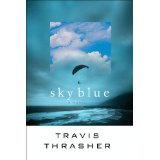
    Travis Thrasher is one of my favorite authors. I love his writing. I do. I love that he does different things in style like use stream of consciousness in the middle of dialogue or scenes. His voice is his own, identifiable, and, yes, usually angsty, but so real. Unique. Gratifying for this reader.


    Sky Blue was published by Moody Publishers in 2007, and it’s vintage Travis Thrasher. The basic storyline is difficult to pinpoint, the risk of revealing too much ever present. I have to say this novel reminded me of Chris Fabry’s Dogwood only because the hints of where it’s going are so subtle you’re supposed to miss them. And like Dogwood I’m not sure I “approve” of the ending, but the journey is well worth the trip through the pages. And even that journey is part of the book’s experience.


    The chapters of this book are titles of famous novels and the main character, Colin Scott, is a cynical literary agent at a top firm. When the story opens, he and his wife Jennifer, who designs costumes for movies, have been unsuccessful in starting a family, and this struggle weighs on their relationship. Jennifer decides she needs time and space and leaves Colin to work on a film, only this time she doesn’t know for sure when she’ll return. Colin is in the process of losing clients and hating most of his authors and their self-seeking drivel. With the lack of a family issue presiding over his melancholy and his wife’s frustration and pain, he’s lost the fire for his work.


    When Jennifer finally returns with a tentative hope for their marriage, at Colin’s insistence, the couple takes off for time together in Cancun. His only work-related chore for their visit is to read a novel by his agency’s top bestselling author. They arrive in soaking rain and the bad weather hangs around them like dread until their final time there when Jen elects to go parasailing.


    This is a story of love, loss, struggle, and pain. Told from Colin’s first person often snipey and arrogant point of view, we watch him deteriorate while scaling the sheer cliffs of depression before plunging off the deep end of utter despair. Tossed into the strange mix of emotions he experiences two wannabe authors who use opposite tactics to attempt to get his representation. Faith issues surface, but he wards them off with a stubborn rebellion. When reality finally claims him back from his self-imposed exile, life embraces him in a fullness he only dreamed.


    The title Sky Blue holds dual meanings. The publishing picture painted in the pages of this story lays bare the potential ugliness in a business that can of course be all about the money. Travis does a masterful job of capturing the cynicism and cutthroat breed of some people in the biz plus depicting Colin’s struggle with the common problem of managing work and family and being able to define what’s truly important in his life.


    If there’s a weakness in this story, it’s Jen. Her fading in and out without reasonable explanations or a desire to arrive at—or to insist upon—concrete evaluations of who they are and what they intend to do in their relationship frustrated me. However, since the story was told through the eyes of her husband and his skewed observations of so many things, it also fit the storyline which I know sounds like a contradiction. You’d have to read the novel to understand this dichotomy.


    I’ve read a couple of Travis’s novels that I didn’t like, but I always enjoy the way he tells the story. He’s a favorite, and Sky Blue presents one of those stories that lingers after you read the final page. I might not have liked certain elements of the story in the final evaluation, but I loved the journey and the writing to get to “The End”.


    41E25KB73gL__SL160_AA160_ 


    Father, you know the challenges Travis faces. You’ve given him perseverance and an undaunted spirit. May you be his ultimate provision, hope, and inspiration for all he does. Continue to bless his life and stories. In the Name of Jesus, Amen.

  •  

    Mankind’s definition of Love:


    And now I will show you my most excellent way.


    If I speak in the language of men and of women but have not my understanding of love, I am only a repetitive instrument that is like a harsh clang. If I have the gift of prophecy (which surely I do) so I can fathom all mysteries and all knowledge, and if I have a faith that can change doctrines, but have not my definition of love, I am old school. If I give all I possess to the poor and surrender my body in the flames (which I surely won’t), but have not my evidence of universal love, I gain nothing (for my ego or otherwise).


    Love is impatient because it’s so urgent that people get the right idea, love is nice. It does not clamor after others’ successes, it does not brag except when explaining my absolute philosophy of the definition of love, it isn’t really proud per se since I’m right in finally defining it realistically. It isn’t rude or self-seeking except when I don’t condone the so-called biblical definition of love which is short-sighted, and most of the time it’s not easily angered except when others point out what they contend are flaws in my definition, and it doesn’t record the many wrongs others find in my philosophies. Love does not celebrate or really punish evil but rejoices in my clear definition of what I think love should be and therefore is. It always protects everyone’s sins, always trusts that everyone makes it to heaven one way or another, always hopes my ways are irrevocably true, and always keeps convincing more people of my truth.


    Love can’t fail by this definition.


    I Confessions 13:1-8a (NP-S Translation according to the emerging religion of old-age philosophy)


    God, you’ve made it all so clear for the ones who have “ears to hear”. Please, Lord, bring more to the Truth of who you are and forgive us for being so self-righteous, so utterly wrong. In the Name of Jesus, Amen.