Into the Fire

Passionate thoughts about the world of writing and the Power of God

  •  

    Published in 2004 by Moody Publishers, Gun Lake by Travis Thrasher collects a group of misfit characters at a Michigan resort lake and entwines their lives.


    The Stagworth Five escape the Georgia prison under the leadership of one Sean Norton— the man with the plan and a guy who fancies himself a clone of Jim Morrison (of The Doors). Accompanying him are four other men who’ve committed various crimes. The most offensive of these five is a loosely reined in rapist named Lonnie who only adheres to Sean’s instructions. Hand-picked by Sean for various reasons, Lonnie eventually becomes a liability. Wes, the tattooed muscle, Kurt, the mostly steady thinker, and Craig, the nice guy who loves movies and making lists of his favorites, make up the rest of the five, most of their activities and associations being told through Kurt’s and/or Sean’s viewpoint, and Kurt has no use for Lonnie. Sean takes them through Texas and up to Michigan where he rents a cabin at Gun Lake posing them as youth pastors on a retreat.  


    An alcoholic deputy forfeits his wife and two sons because of his refusal to quit drinking in spite of all the promises to do just that. His illusions of finding respect generate a bonehead move to take down the criminals.


    The pretty young Norah fleeing her abusive fiancé who never plans to marry her winds up at Gun Lake near where she grew up.


    Michelle and her husband Ted have run out of ideas on how to reel in their rebellious teenage son. Church, grounding, and every other method of parenting they’ve tried have all failed miserably, and Jared has become a thoughtless punk. Michelle takes him up to Gun Lake in one last effort to right his flagging ship.


    Paul leaves his casino bartending job to go settle down at Gun Lake, grieving private mistakes and the death of a woman he wanted to be his girlfriend.


    Ossie made a promise to one Sean Norton a long time ago while spending 27 years at Stagworth, and now he figures he’s obligated to keep that promise when Sean comes knocking at his apartment door. He’s a solid working ex-con who loves the Lord Jesus, but he’s stuck making good as a man of his word.


    I don’t know how exactly Travis was able to keep me interested in this novel since the only character I found remotely sympathetic was Ossie. His dilemma fit him well, and because he kept earnestly trying to do the right thing but faced one conundrum after another, he managed to generate empathy.


    Quite frankly, all the rest of the guys and gals came off as losers. Sean’s attraction could be understood because his looks and charm were played up. Kurt showed both sorrow and remorse until Ossie gave him chances to warm up to the gospel. His ire increased as his conviction worsened. Lonnie was a plain sociopath. Wes was short on smarts and impulsive but willing to place his loyalty and trust in Sean. Craig seemed simple, perhaps that’s what got him into the pen in the first place—a lack of reasoning.


    Michelle came off as inept and without faith or much compassion, legalistic. Her son Jared was just an uncommunicative punk until he got the you-know-what scared out of him. The instant transformation seemed a bit forced.


    Norah’s beauty was her beacon and she didn’t seem to know how to rise above her looks or her desire to be with a man.


    Don the deputy was a typical drunk who refused see beyond the next bottle or glass.


    Paul’s the misguided loner escaping life’s responsibilities and a private fear.


    It’s one thing to demonstrate unlikable people and show the reader that they could be us if just a few things had happened differently in our lives. But in order to do that we really do need to care about them. I couldn’t muster up the ability. That’s where fiction remains separated from real life. I don’t have to care about them in a novel. They have to touch that tenderness in me before I can invest in them. And, sorry, only Ossie managed to do that. Maybe it’s because when you paint these ugly pictures of humanity, we’re forced to look at our worst selves. Since we must do that sometimes daily, who wants to spend an entire novel repeating it? The truth is we are all without excuse, but all these people did was make excuses for their behaviors or blame a God they claimed not to believe in for their lots in life. 


    This novel is really a multi-character study of a bunch of lost people—not just spiritually. Their reasoning skills center on themselves and their needs (which I know is typical of us all when we don’t know the Lord, and even many times when we do). They’re weak, simple, and most of them fail to see themselves as they truly are and argue with themselves and a solicitous voice that tries to help them see how it really is in their lives.


    The climactic scene works in bringing this brood together and finalizing the depravity of some and the almost heroics of others.


    Song titles were used as "parts" divisions which is a favorite tool of Travis Thrasher—and an often very fitting commentary on what’s to follow.

     

    10318eb_w185 


     http://www.amazon.com/Gun-Lake-Travis-Thrasher/dp/B003UHU7PI/ref=sr_1_1?s=books&ie=UTF8&qid=1307579439&sr=1-1


    Father, you’ve given Travis a widespread imagination. Keep filling him with stories to honor you, and he’ll write them. Bless him for staying firm in his writing. In the Name of Jesus, Amen.
  •  

    Nothing can put you in the maelstrom of fiendish thinking like comparisons. Few people can be objective when comparisons involve them and others. Some over-evaluate themselves and others devaluate themselves. If you care to engage in the losing wager of comparing your writing skills to those of others, pick someone to do it who neither knows you nor the other writers you suggest as comparable.


    Between the heavenly and the hellish, the glorious experience and the crucifixion of self, there exists the earthly expenditure of being a committed writer. The effort made, the discipline required, the persistence explored, the encouragement received, the rejection guaranteed—all of these a potential reality in the process.


    The expectations of us as writers probably vary as much as our writing itself. Who we perceive ourselves to be and who others assume we are can create a gap as vast as the Grand Canyon. We can have the proverbial illusions of grandeur or the assumptions of abject failure present in our creative concepts of ourselves. “Realistic” need only apply to the unemotional, indifferent, or the pessimistic. Manic/Depressive to use the old term for what is now referred to as Bipolar holds a closer than comfortably admitted description of the ups and downs of penning fiction. No insult intended toward those who truly suffer from the malady . . . of both.


    And speaking from a pseudo-objective opinion, most stories dwell somewhere between the heavenly and the hellish—in subject matter and the written words. Few can elevate their writing to the sublime. And who decides that elevation has indeed been reached. The scaling of words is less definitive than the conquering of a mountain, planting a flag or marker, noting the ultimate achievement of reaching “the top”. Some “mountaintops” are mere hills. Certainly not Everest. Yet each speaks to the one who scrambled and fought to arrive there.


    That perfection so many chase will not be caught here on earth. We’re flawed and although regenerated in Christ, our redemption for this cursed flesh draws near but remains illusive in an unpredictable timeframe. We write from our base of somewhere between the heavenly and the hellish and hope to God it matters.


    God, only you know the value of our work—how much it matters to you. Thank you for the privilege of writing words. May they be pleasing to you above all else. In the Name of Jesus, Amen.

  •  

    Only myself. This is one of those posts where the true confessions erupt from common sense evaluations. Where the pensive gives life to the faith and trust issues. The place where every writer drives their thought processes to and parks at the cliff of a designated lookout point.


    I’ve written posts about many topics in the writing/publishing venue. Gone over the nonsensical and the meaningful. Gathered interviews from editors and authors who gracefully shared their perspectives on the industry, writing, and business of it all. Gazed into the biz as an outsider. Gained a great deal, disliked a lot, valued some issues, and established some incredible relationships with published and pre-published writers. Gambled at publishing from the custom end of things.


    As important as connections and networking are, they don’t measure up to real relationships. I’ve gained some genuine friends via this format and others' blogs and by contacting authors with heartfelt praise for what they’ve written. The respect I have for those who plod through the doubt, the empty words which often surface in the process of writing, the distaste of selling one’s product with no guarantees of “success”, the hours of self-imposed (and often desired) solitary confinement as they construct what they hope matters to someone and preferably many someones, is enormous. I can say I know what it’s like and mean it.


    As much as I’ve learned, it’s probably still a pittance compared to those in the trenches of this morphing industry of traditional publishing. Not completely sure I’m a fan. Love fiction. Will always read it and hope to always write it. I’m on the verge of another custom-published novel venture. Notice how I tucked that information into the fourth paragraph, fifth sentence (including fragments for all you rule nags). Many will have stopped reading by now or skipped right over that assertion. Just as well because it’s a ways off and I’m not promoting it yet. I do know one thing for sure. Whether or not it’s a fool’s venture, it’s a necessary choice for me. At this point.


    So. Kidding myself by believing my novels have merit, value—that they’re potentially meaningful to those who choose to read them? Probably. But from the edge of the cliff looking at the spectacular view of life, my vision is limited. However, I know the One whose vision sees forever. I know the One who exudes grace to me as my heart-cry longs for Him. I know the One who tempers dreams according to His will. And I know the only One I truly must please. I can’t see any farther than Him.


    God, it’s all about you. All the time. In every way. In the Name of Jesus, Amen.

  •  

    If you’ve been one of the many who’s complained about the writing in Christian fiction, you’ve probably never read a Lisa Samson novel. Unapologetic in tackling faith issues and gospel rendering, the stories come forth in soulful prose with unusual characters and topics, rich in themes and thoughts. Lisa ranks up there with the best—and no qualifying her ability with additions such as “in Christian fiction”. She’s that good.


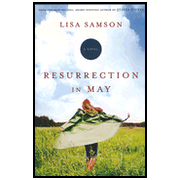
    Resurrection in May, published by Thomas Nelson, gives the reader a two-part story, the first focusing on the elder mixed race lifelong bachelor Claudius Borne who has operated the family farm, Borne’s Last Chance, alone since his step father first and later his mother Violet passed away. One afternoon Claudius returns from a favorite scenic viewpoint where he often goes to ponder God and his life to spot a pretty young woman by the side of the road barfing. He’s a natural rescuer, and she (May-May as he decides to call her) agrees to let him help her after a rowdy evening. They form a unique friendship when she comes to live with him on the farm before she’s scheduled to take a trip to Rwanda to assist a priest in a village. May-May learns the quality of life in growing and gathering, and the peaceful existence she shares there with Claudius provides a refuge she didn’t realize she needed.


    Once she goes to Rwanda and establishes herself in the village, the colossal massacre explodes and May eventually returns from the conflict a damaged young woman in every way. Her father asks if Claudius will take her back at his farm, broken-hearted that he and her mother who’s suffered a stroke are unable to provide what she seems to need for healing.


    As Claudius administers his clumsy brand of healing and love, May-May begins to function but clearly doesn’t heal from her searing pain.


    Part Two shows us the agoraphobic, passive-aggressive embittered May who lives at the farm in a small world of animals, produce, flowers, Claudius’ and her friend Sister Ruth, and Glen the mailman. In time she writes to and receives letters from a college friend (Eli) who’s on Death Row for murder seeking no appeal. Over many letters a true friendship finally takes place which exposes both of their prisons as well as their personal and spiritual needs.


    To reveal any other plot points of this story would be to ruin the journey which is all of painful, tragic, and redemptive. The method Lisa uses to tell this story gives us the asides and the language of each individual so that we know them intimately. May’s efforts to clone both Claudius’ and his deceased mother’s purpose in her habits and eventual speech patterns service her will to live. The eventual encouragement she receives from Eli pushes her into approaching genuine healing.


    People and even animals come alive and also die on the pages of Resurrection in May. We hear their voices and even their attitudes through dialogue, thoughts, and letters. We suffer through their choices and feel their emotions. Although I think the novel loses something—and rightly so, I suppose—in Part Two, it gives the reader plenty to maintain a sometimes morose involvement while hoping for the real resurrection of a life.


    Anyway, Resurrection in May captures the interlacing of life in a small Kentucky town, the struggle for wholeness that comes about in a strange union of souls, and the resurrection power of God’s patience with the fallen and bruised. Lisa Samson is a unique and oh-so-talented storyteller. For quality fiction lovers this is a must read.


    545442 


    http://www.amazon.com/Resurrection-May-Lisa-Samson/dp/1595545441/ref=sr_1_1?ie=UTF8&s=books&qid=1307195406&sr=1-1


    Father, thank you for the insights you’ve given Lisa. Please continue to provide the inspiration in stories for her writing that glorifies you and displays the wonders of your giftings. In the Name of Jesus, Amen.

  •  

    "I did not send these prophets,

    yet they have run with their message.

    I did not speak to them,

    yet they have prophesied.

    But if they had stood in my council,

    they would have proclaimed my words to my people

    and would have turned them from their evil ways

    and from their evil deeds.

    "Am I only a God nearby," declares the Lord,

    "and not a God far away?

    Can anyone hide in secret places

    so that I cannot see him?" declares the Lord.

    "Do not I fill heaven and earth?" declares the Lord.

    Jeremiah 23:21-24 (NIV)

  •  

    Excerpts from the ACLJ:


    It has been well documented that Iran directly influences Hamas, with many calling Hamas a "puppet" terrorist organization for Iran. Now, Iranian President Ahmadinejad's spiritual mentor is calling for suicide attacks against Israeli civilians – including Israeli children – saying that such attacks are not only "allowed," but are even "an obligation."

    The impact of these statements cannot be underestimated. It is clear that Hamas has the blessing of Iran to continue its brutal terror attacks against the people of Israel.

    To side with Hamas is to not only side with the terrorist organization, but also to fuel the dangerous Iranian regime. We must show our support for Israel against these outrageous attacks.

    The threat posed by Hamas and its Iranian backers against Israel continues to grow daily, and it is one we must take very seriously.

    Hamas has not only succeeded in infiltrating the Palestinian Authority by joining in the "Unity Government," but there is evidence that their terrorist influence is radicalizing the Palestinian government. Today, there are reports that members of Fatah – the supposedly "moderate" party that has joined with Hamas to form the "Unity Government" – are doing exactly what Ahmadinejad's spiritual mentor has urged and are now under investigation for planning suicide bombings against Israeli civilians.

    We must urge President Obama to reverse his support for the Iran-backed, terrorist-led Palestinian government, stop fueling the terrorists with the use of their language by calling Israel a force of "occupation," and withdraw his call for Israel to return to the indefensible 1967 lines.

    It is crucial for us to take a stand now, before Hamas joins the Palestinian Authority, which could occur within the next two weeks.

    Jay Sekulow,
    ACLJ Chief Counsel


    Father, we're desperate for you. We pray for the peace of Israel, knowing the Prince of Peace is you, Jesus. In the Name of Jesus, Amen.

  •  

    Purpose: (noun)1. the object for which one strives or for which something exists; goal; aim 2. a result or effect which is intended or desired intention 3. determination; resolution 4. the matter at hand; point at issue


    Meaning: (noun)1. that which is signified by something; what something represents; sense; import; 2. that which one wishes to convey 3. that which is interpreted to mean the goal; intent, or end 4. that which is felt to be the inner significance of something 5. functional value, efficacy; significance


    I think we all do things with purpose and hope they elicit meaning in our lives. And although both of these definitions incorporate the word “goal”, it would seem that purpose is more associated with achieving or determining a goal or goals. Using goal in the definition of meaning adds the qualifier as “interpreted to mean”.


    To find that life is purposeless or meaningless is to give up on it. And it seems in order to conclude either is to decide that what we do determines nothing in the grander scheme. We live. We die. We cease to exist.


    Christians live with both purpose and meaning. Within that framework do men seek purpose perhaps more than women do? Do women seek meaning more in what they do than men? As a woman, I need what I do to mean something. Yes, it probably serves a purpose as well, but if it doesn’t serve to be meaningful, it feels like it loses something for me. And there it is, isn’t it? The word “feels”. The emotional content or the tactile word screams “female!” does it not? Purpose, goal, aim: manly words, intentions. More concrete and unemotional. Set it in motion, accomplish it. Don’t ponder its overall significance. Just do it.


    Just some of my thoughts this Friday. Yours?  


    Father, I know I have purpose in you, and you allowing me to accomplish things which are meaningful or in a meaningful way fulfills me. I thank you for that. Apart from you, I can do nothing. In the Name of Jesus, Amen.

  •  

    Do men look more for purpose in the things they attempt?

    Do women look more for meaning in the things they attempt?

    Do you think there's a difference between purpose and meaning and their potential objectives?

    Any thoughts on this obscure question?


    Lord, you've made us different for a reason. You put us together for the ideal fit. Sin ruined the union of souls, spirits, and bodies. Help us to serve one another. In the Name of Jesus, Amen.

  •  

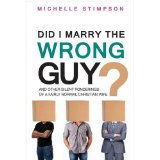
    Finally a book for every wife who has ever asked herself the question, "Did I marry the wrong guy?"


    Many of us know the Titus 2:4 mandate for older wives to mentor younger wives, but is that really happening? For real? I mean, yeah, yeah, you hear people talk about working together and making sure you keep that "date night" thing going, but there are other issues to contend with in a marriage. Issues like feeling trapped, mourning the death of "single" you, and feeling like maybe you should have married what's-his-face instead of the man sitting next to you who just misplaced the remote control. Again.

    Sure, many Christian wives face problems bigger than lost remote controls. But I believe the smaller, negative "ponderings" wives entertain about their husbands are what catch, snag, and slowly unravel the fabric of a marriage. Larger issues, infidelity and financial chaos, to name a few, are often predicated by these smaller thoughts that create undercurrents of resentment.

    To that effect, I was blessed to write Did I Marry the Wrong Guy? And Other Silent Ponderings of a Farily Normal Christian Wife. Some of the chapter titles include: We Started Off Wrong, I Miss the Thrill of Being Single, and Watching My Parents Messed Me Up. I have had the life-changing experience of marrying all wrong, then watching God completely demolish my marriage before re-building it from the ground up. (Trust me, there was nothing to salvage.) One of the most important lessons I learned during the renovation was to pray about things I never thought God even cared about. I mean, everyone knows you should pray for your husband if he falls into an addiction, but who teaches us to pray about his wall-shaking snoring? Seriously, crankiness due to lack of sleep attributed to somebody's snoring has probably killed more marriages than in-law issues and bad cooking combined!

    In this book, I encourage every wife to pray over even the smallest irritants. I'm not talking about a generic, "God, help us have a nice day," prayer. I mean, get in that prayer closet and confess, "Lord, I am tired of him leaving his shoes at the door every day! Show me what to do!" God might change your husband, or give you joy while transporting his shoes to the closet every day, or He might teach you to ignore the shoes – His choice depending on His lesson objective for you.

    It's been said that every marriage is a foreign land. I trust that Did I Marry the Wrong Guy? will help readers navigate unfamiliar roads. And with God's help, they'll be able to answer the title question with a resounding "No".

    Keep the faith.

    In His Love,

    Michelle Stimpson


    51ty1xBBtxL__SL160_AA160_ 


    Father, let the wisdom and honesty shared by Michelle Stimpson be shared with all of those who desperately need to hear it. Bless Michelle for her heart after you. In the Name of Jesus, Amen.


  •  

    My guest for the next few days, the lovely and talented Michelle Stimpson.


                                                        GetAttachment


                                  Michelle Stimpson – Biography


    Bestselling author Michelle Stimpson has penned several works, including Boaz Brown, Divas of Damascus Road, Last Temptation, and her upcoming release, Someone to Watch Over Me. She has also published more than forty short stories through her educational publishing company. Michelle holds an English degree from Jarvis Christian College and master’s degree in education from the University of Texas at Arlington. She is a part-time language arts consultant and serves in the Creative Tyme ministry at her home church, Oak Cliff Bible Fellowship. Michelle lives near Dallas with her husband, their two teenage children, and one crazy dog.


    www.MichelleStimpson.com


    Father, you know Michelle's heart for you. I pray your continued blessing upon her and her family and her writing. Continue to give her the inspiration she desires to communicate truth to your people in both fiction and non-fiction. Be her guide and protector, Holy Spirit. In the Name of Jesus, Amen.