Into the Fire

Passionate thoughts about the world of writing and the Power of God

  •  

    Mike Dellosso is a self-described writer of Christian horror, a term rarely used by any “official” in the publishing industry. Yesterday on Mike’s blog he brought up the frustration he feels regarding the various labeling of genres.


    Opinions vary as to the labeling of Christian fiction. Some think there are already too many, others think not enough. We all know there are some novels which absolutely defy a niche label.


    I’m not a fan of the “Speculative” label. I think it’s a catch-all for types of fiction some publishers don’t want to admit to producing such as “Christian” Sci-fi or “Christian” Fantasy. And even in some cases “Supernatural” this, that, or the other. Supernatural attached to a label seems ridiculous to me. Where any Christian theme is involved, the supernatural exists. It doesn’t really matter what God-concept an author engages, if, in fact, God or Jesus or the Holy Spirit is involved overtly or peripherally, you’re talkin’ supernatural. Angels, demons, miracles? Supernatural. And biblical supernatural is a far cry from the speculative in sci-fi or fantasy. While either science-fiction or fantasy can employ biblical themes and methodology, isn’t it just simpler to label a book Sci-fi or Fantasy so the reader knows what to expect? And any qualifiers can be added in the back cover copy.


    The horror label shouts at readers and reverberates “Scary!” It’s an honest label for Mike’s novels, but no one tends to associate “redemptive” with the word horror. The Christian moniker in front of it only seems to create an oxymoronic reaction so much of the horror genre is pushed into either “Suspense” or “Thriller” categories. I’d put Mike’s in the Thriller group because Suspense is usually less gory, grotesque, intense (though not always), and more subtle.


    What do you think about the “speculative” label?


    Lord, let us be true to what you have for us to do. In the Name of Jesus, Amen.

  •  

    Those of you who read this blog on a regular basis know this novel was scheduled to be reviewed a couple of weeks ago on the CFBA Tour. There was a problem with the distribution of the book so I received mine a few days ago. Coinciding with the promotion of Ted Dekker’s latest release Immanuel’s Veins, Thomas Nelson offered the T-shirt giveaway, a contest which WordLily won with her determined additions of “T-shirt” following her comments. Thank you to her and to Dayle for participating.


    So. The review of this long-awaited release. Well . . . if I had known the approach this story was going to take, I wouldn’t have ordered it. Fine thing to say after all the emails and so forth which took place to secure a copy. Here’s the thing: Immanuel’s Veins is both a historical novel and speculative fiction. And I’m not exactly sure how to review it in light of how it’s being promoted. Part of me doesn’t want to include the “surprise” in the speculative part, but the other part wants to alert readers like myself who are not inclined at all to engage or enjoy this vein (pardon the pun) of literature.


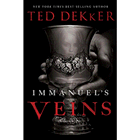
    First up: a beautiful and enticing cover jacket which fits the story perfectly. The color, the illustration, everything. An exceptional cover.


    The book itself keeps the telltale black and red hardbound cover along with “antique” pages to fit that of an old journal. Preceded with heartfelt commentaries by those who were apparently spiritually moved and somewhat “awakened” by the story, it’s a different and appealing approach to recommending a novel, replacing author endorsements.


    The story is told mostly in first person by Toma Nicolescu, young and dashing Russian warrior-supreme and servant of Catherine the Great. Sent politically and strategically to Moldavia to guard and protect a mother and her two daughters at the Cantemir Estate, who happen to be renowned for their beauty and behavior, Toma is accompanied by his fellow warrior and closest friend Alek who is also the modern equivalent to a player. On the final approach to their destination, Toma is warned by a strange fellow and a crow of impending danger but, while intrigued, finds it hard to take him seriously. Near the beginning it seemed there was a hint of some 21st century dialogue which seemed a tad out of place, but it was minimal.


    Toma is the ultimate soldier whose sworn allegiance to Catherine makes his intense attraction to the lovely sister Lucine take a backseat to his duty while his friend Alek wastes no time pursuing Lucine’s wild twin sister Natasha.


    When certain mysterious Russian guests arrive for a Ball, Toma’s suspicion of the lascivious group eventually leads him to fire a shot, killing one of their group who threatened Alek. This is only the beginning of this group’s infiltration into the lives of Toma, Alek, Natasha, and Lucine. When Alek and Natasha succumb to the group’s strange activities at their Castle Castile, Toma and then Lucine decide to rescue them.


    The “rescue” turns into a seduction. The novel is filled with an unearthly sensuality and the brazen display of lusts by the members of the coven of the castle. Irresistible to the so-inclined passions of Alek and Natasha, there will be no “rescuing” their souls. When Toma barely escapes the vacuum of their hypnotic elixirs and lures, his one compromise repels Lucine’s love for him and propels her to become the victim of the king of the castle who desires her for his bride.


    Toma discovers for the first time in his life he is no match for these strange and powerful foes, and he learns out of sheer necessity and a new humility there is only one Blood with which life can be restored.


    Although touted as a story of redemption, Immanuel’s Veins is really more of an ancient tale of love and lust, life and death, good and evil. And, yes, in the end it becomes redemptive. The interpretation of Nephilim references in scripture always amuses and sometimes annoys me. I find it interesting that many people believe demons can “produce” life when God is the only Author of Life. Demons possess people and occasionally animals, but they do not of their own power produce semen and make babies. Huh-uh. However, those who they infiltrate can do just that. So this tale takes many liberties in its interpretation of such references, but in the overall picture the important part is the real Power in the Blood . . .


    . .  . And in the source of true Love, the heavenly kind, the real kind, the only kind. The Love who is God. The Justice which is God. The Mercy that exists in God alone. And the Blood which overcomes sin when it flows from Immanuel’s Veins.  


    For those who love ancient stories that depict sensuality in all its forms, the power of sin and deceit overwhelming the human heart, and the picture of pure evil accomplishing its mission and revealing its nature, Immanuel’s Veins gives you this experience. For those who want the evil contrasted to the good, this novel is a prime example of salvation coming to those who clearly don’t warrant it (and, yes, I realize none of us do) but are allowed to search for it and find it when all other means of hope have been extinguished.


    In spite of the speculative premise I will admit the story held my interest. This is largely due to the character of Toma and his clumsy handling of utter desire when his loyalty to duty is challenged. Ted skillfully brings him to the place of giving his life away in order to save the one he loves—a familiar redemptive theme.
     

    540091 


    Father, the desire is always to honor you. Please continue to bless Ted as he pursues you and seeks after the stories which will bring people to the Cross of Christ, the Blood of the Lamb. In the Name of Jesus, Amen.  

  •  

    When I came to you, brothers, I did not come with eloquence or superior wisdom as I proclaimed to you the testimony about God. For I resolved to know nothing while I was with you except Jesus Christ and him crucified. I came to you in weakness and fear, and with much trembling. My message and my preaching were not with wise and persuasive words, but with a demonstration of the Spirit's power, so that your faith might not rest on men's wisdom, but on God's power.

    I Corinthians 2:1-5 (NIV)

  •  

    The INSPY AWARDS SHORTLIST:

    http://inspys.com/?p=405

  •  

    I see through you.


    The sweet voice and gentle way.


    A trap you learned.


    Exercise in control.


    But I see through you.


    I used to mourn for you.


    But now I’m reviled.


    You’re a predator in silk voice


    And lace camisole.


    Fierce and fluff


    Blended with arsenic—


    Emitting a slow death.


    Unawares the poison


    You spread grows within you.


    I watch its liquid reaching


    Like cancer.


    I see through you.  


    God in heaven, only you know what’s next. Mercy and Justice. All we can ask. In the Name of Jesus, Amen.

  •  

    Back to novel reviews . . . As you know I rarely read reviews until after I’ve read a book. Too much information even by the most delicate reviewers who take extreme care not to reveal intricate plot points or spoilers of any kind. I’ve mentioned here that I usually read one or two sentences of the back cover copy and that’s it. I want to enter into the experience of a story without expectations for the journey. This is often impossible because some novels I read by well-known authors get hyped to the max, and it can be difficult to circumvent all the information.


    Even a year ago I would’ve been less selective of the novels I choose to review. When selecting a book from the lists provided each month by the Christian Fiction Blog Alliance and the list I receive from Revell, a division of Baker Books, I now take more time to decide if I want to invest in each story. By “time” I don’t mean minutes or hours, I mean I read over the blurb a few times and ponder why I’m somewhat attracted to the story or if it’s easy to say yes or no.


    Some of the novels I’ve said yes to will not get another chance. Others I’ve given second chances and there will be no thirds. In a way this saddens me. I’m a loyal person, but as all of us writers know too well, there are many, many books and not so much time to read them. Therefore we want the time spent reading to be meaningful—however “meaningful” is personally described.


    I’m a loyal-type person. Authors I love will get me to their novels every time. I’ll find a way to read them even if they throw in a disappointing selection now and then. The reason they’re a favorite is because of their writing—their voice and style, and how they tackle their stories—whatever genre they’ve chosen.


    So . . . back to reviews. I will not tear apart a novel. You know I’ve given a few bad reviews. Certainly not to hurt the author but to alert like-minded readers that the particular novel will not be a book for them. There’s no way to give a “nice” review when you hate a book. But there’s no point in crushing the author’s effort with thoughtless comments. The best choice is to give your opinion and acknowledge that’s all it is: one opinion.


    It’s also important to note (again) I review the novels I signed up to receive free in exchange for posting a review. I’ve chosen not to review several novels (I’ve bought or otherwise received) I either disliked or those which evoked ambivalence.


    How do you feel about reviews? Do you read them? Do you only read them written by particular people? What do you expect from a review?


    Lord, you know my heart for your writers. Help me to give my opinion with grace. In the Name of Jesus, Amen.   

  •  

    Words. So many. So few. Expressions. Clichés. Slang. Accents. Profanity. Vulgarity. What are writers to do with these words?


    Let’s talk about clichés. We all know them well because most of us use them frequently in conversation without even thinking about them. They’re common in everyday talk. We recognize the comparisons, the similes. We understand their meanings because they wouldn’t have lasted this long or kept their familiarity if they weren’t descriptive enough to help people accentuate the moment or circumstance. Are they valuable? They hold their own place, or niche if you prefer, in the language.


    But in writing fiction? They’re supposed to be kept to an absolute minimum. I’m suggesting the best place for them is how most people use them: in conversation. That’s where their commonality is acceptable. If an author uses them frequently elsewhere, I can’t help but wonder why. Is it because they’re writing to a specific audience who can relate to those phrases without noticing how well-worn and unimaginative they are when used to depict a particular emotion or situation?


    Many industry professionals insist authors not write “down” to their readers. That premise is rarely backed up in what they publish. They fail to admit that their major demographic doesn’t separate “good” writing from bad. The average reader does not hone in on clichés or adverbs or dialogue tags. Writers do. And some editors.


    Once again it comes back to the main thing: it’s all about story. And what appeals to one demographic will cause another to gag. Bonnet books vs. horror. Thrillers vs. category romance. Usually not tight couples. But writing is writing you say. Not so to many readers. There are some readers who couldn’t identify a noun from a verb, and the fact that the words they just read are known as clichés makes no never mind to them. In fact, those words just gave them a familiar understanding with which they can relate.


    So, I wonder if clichés are ignored if certain novels are geared to reach a particular demographic . . .


    Lord, all I need to do is write what you give me and do it the best I can. You’re all I’m livin’ for. In the Name of Jesus, Amen.

  •  

    Born naked with a hole inside our souls. We cry for what we want. If we’re not content, we cry some more or whine. We don’t have tangible reasons for our distresses. We simply react to them. Hunger, pain, discomfort, fear, fatigue—we cry.


    Growth produces more demands and our goals amplify in order to satisfy this nagging flesh which knows no satisfaction. Temporary fixes abound but no permanence for our wants even when our needs remain complete.


    Environment dictates habits, cultures, attitudes, even the way we walk, talk, and think. Are we upbeat or downcast? Do we like others or do we shun the populace? Are we drawn to God or is He a philosophical stranger?


    When is our soul sated? When do we stop feeding our flesh in hopes of the release from its incessant gnawing for more? How do we become a quieted soul?


    The yearnings in our hearts take us on journeys. Roads of experience which lead to all kinds of destinations vie for our attentions. The directions confuse us and make the choices unclear. Uphill or downhill or the monotonous straightaway. Which one? All or none or some?


    Self-satisfaction chooses us. We ache for it, demand it, corner it to make it ours. But it fluctuates, veers off into invisibility, emptiness. What is this thing called life? Why am I here?


    Answers compete. We often succumb to easy ones which make no sense, but who wants to confront the depths of infinity? All of it seems so complex.


    We tangle with theories but realize they provide no reality.


    One day the vacant hollows within us threaten to rob us of a viable future inside ourselves. This desperation seeps in like a putrid, rancid ooze. We’re dying inside. Regardless of family, loves, friends, possessions, death lurks. Taunts. Squeezes. The breath threatens to hold back. God! If you’re there . . .


    He is. Not only “there”. Here, too. And everywhere. Pulling us with a gentle tug—that light sensation we’ve been ignoring for who knows how long. And suddenly we feel it. It’s Him. The fact that He could want anything to do with us after . . . after it all amazes us. And consumes us. Might He?


    Sin envelops us. Takes on a new and real definition. Flashes like a neon sign. Each time something new in our lives. Each one in vivid color. A mess. A horrid mess. We see who we are. And finally . . . we see who He is.  


    The Way, the Truth, the Life. No other way, or truth, or path to life.


    Salvation.


    Savior. Jesus Christ.


    The right journey begins . . .


    Thank you, Lord. King of Kings and Lord of Lords.

  • Wanda L. Dyson’s latest novel Judgment Day, published by WaterBrook Press and featured in this week’s CFBA Tour, presents the unlikely but likable couple of 6’ 6” “working-class stiff” Marcus Crisp and blue-blooded, real moneyed Alexandria Fisher-Hawthorne as a team of private investigators who along with their computer wizard partner Razz take on an investigation involving Marcus’s ex-girlfriend from college, Suzanne Kidwell.


    Marcus and “Alex” pretend they’re just friends and their smart, clipped verbal conversations and nuanced silent communications bring back memories of an old British television series The Avengers. Alex is a woman of faith and an independent gun-toting investigator who has no intention of returning home to take over the family mega-bucks business in spite of her father’s efforts to convince Marcus to make her do so—as if he could. When her mother needs a new heart, the pressure increases for Alex to go home.


    Marcus appears to be a man of faith, understated, smart, careful, and willing to pass on the investigation involving the imprisonment of his college ex, but Alex overrules his hesitancy when she evaluates the information Suzanne presents. Other than that we learn little about Marcus.


    Suzanne is the stereotypical, cut-throat, narcissistic reporter of the television tabloid news show “Judgment Day” where incriminating information is plentiful and sensational but backed up with few facts. Circumstances which are just too obvious to ignore ignite the desire in Alex to pursue why Suzanne is being framed for a murder she didn’t commit.


    Razz reminds me of the geek in NCIS Los Angeles with a few extra baubles and piercings or Vince Flynn’s computer wizard in his stories. Razz himself is a great character, but the situation with his wife seems added on, unbelievable, and handled poorly. Granting that many very intelligent individuals seem to compartmentalize emotions and appear totally rational, his reaction and his partners’ reactions to the circumstances just don’t compute for me at all. Weak and unbelievable plot element that shouldn’t have been included in my opinion. (Remember: it’s just my opinion.) 


    Since Judgment Day reminded me of a novel I read earlier in the year and of episodes of Criminal Minds, The Closer, and CSI, the plot seemed well-worn. The co-protagonists and their partner provided some enjoyment and a fresh combination and perspective to the P.I. genre, cleanly written with some good dialogue, and geared to those who enjoy a commercial quick read. 


    074754 


     http://www.amazon.com/exec/obidos/ASIN/1400074754  


    Father, please continue to provide your fellowship and blessing to Wanda as  she works to give you the glory for all she does. Give her new insights and fill her with stories. In the Name of Jesus, Amen.

  • An argument started among the disciples as to which of them would be the greatest. Jesus, knowing their thoughts, took a little child and had him stand beside him. Then he said to them, “Whoever welcomes this little child in my name welcomes me; and whoever welcomes me welcomes the one who sent me. For he who is least among you all—he is the greatest.”


    Luke 9:46-48 (NIV)